How God’s Rescue Plan Narrows and Expands at the Same Time
If Genesis 3 shows us the catastrophe—humanity’s fall into sin and the curse that follows—Genesis 12 shows us the beginning of the cure.
God does not scrap His creation or abandon His image-bearers. Instead, He initiates a plan to bring blessing and restoration, not just to one nation, but to all the families of the earth. And the surprising way He does this is by choosing one man and forming one people.
This is the next major movement in the Bible’s story: Promise and a People. It sets the stage for Jesus by showing us that God’s plan of salvation is both particular (through one family) and universal (for all nations).
1. God’s Radical Call: Abram and the Promise of Blessing
After the flood and the scattering at Babel (Genesis 6–11), the world is once again full of idolatry and rebellion. Humanity is not climbing its way back to God; it’s drifting away.
Into that darkness, God speaks to a man named Abram (later Abraham):
“Now the LORD said to Abram, ‘Go from your country and your kindred and your father’s house to the land that I will show you.
And I will make of you a great nation, and I will bless you and make your name great, so that you will be a blessing…
and in you all the families of the earth shall be blessed.’”
— Genesis 12:1–3
This promise has three key parts:
- A People – “I will make of you a great nation.”
- A Place – “to the land that I will show you.”
- A Purpose – “in you all the families of the earth shall be blessed.”
This is God’s mission strategy: He chooses one man—an elderly, childless idol-worshiper from a pagan city (Joshua 24:2)—and promises to do the impossible through him for the sake of the world.
Promise, Not Performance
Notice what God does not say. He doesn’t say:
- “If you fix yourself, then I’ll bless you.”
- “If the world improves, then I’ll step in.”
He sovereignly initiates. He makes promises grounded in His own faithfulness, not Abraham’s track record.
This is grace.
2. The Covenant with Abraham: A Foundation for the Whole Bible
As the story unfolds (Genesis 12–22), God reiterates and deepens His promises to Abraham:
- Offspring as numerous as the stars (Genesis 15:5)
- Land for his descendants (Genesis 15:7, 18–21)
- Nations and kings coming from him (Genesis 17:4–6)
- A promise that through his offspring the nations will be blessed (Genesis 22:18)
To confirm these promises, God makes a covenant with Abraham in Genesis 15. In a solemn ritual, animals are cut in two, and God alone symbolically passes between the pieces in the form of a smoking fire pot and flaming torch.
In the ancient world, passing between the pieces was like saying, “May this (death) happen to me if I break this covenant.”
Here, God binds Himself to His own promise.
The message is clear: the continuation of God’s redemptive plan does not rest on Abraham’s perfection, but on God’s unbreakable word.
How This Points to Christ
Centuries later, Paul reflects on these promises and writes:
“Now the promises were made to Abraham and to his offspring. It does not say, ‘And to offsprings,’ referring to many, but referring to one, ‘And to your offspring,’ who is Christ.”
— Galatians 3:16
Ultimately, the “offspring” through whom the nations will be blessed is Jesus.
In other words, when God makes promises to Abraham, He already has Christ in view. The Abraham story is not a side plot; it is a critical stage in the unfolding of God’s plan to bring Jesus into the world.
3. From Family to Nation: Israel’s Birth and Exodus
God’s promise of a people begins to take shape as Abraham has Isaac, Isaac has Jacob, and Jacob has twelve sons—the heads of the twelve tribes of Israel.
By the time we reach Exodus, Abraham’s descendants have become a great multitude in Egypt (Exodus 1:7). But there’s a problem: they are enslaved under a cruel Pharaoh.
Once again, God acts.
The God Who Remembers His Covenant
“God heard their groaning, and God remembered his covenant with Abraham, with Isaac, and with Jacob.”
— Exodus 2:24
“Remembered” here doesn’t mean God had forgotten; it means He moves to fulfill what He pledged.
He raises up Moses, confronts Pharaoh through mighty plagues, and delivers His people through the Passover and the crossing of the Red Sea. Israel is redeemed from slavery and brought to God.
This is more than a rescue story. It’s the birth of a nation shaped by promise.
4. A People for God’s Own Possession
At Mount Sinai, God explains why He has redeemed Israel:
“You shall be my treasured possession among all peoples, for all the earth is mine;
and you shall be to me a kingdom of priests and a holy nation.”
— Exodus 19:5–6
Israel is chosen not instead of the nations, but for the sake of the nations:
- As a kingdom of priests, they are to display God’s character to the world and mediate His presence.
- As a holy nation, they are to be distinct—set apart for God’s purposes.
God gives them His law, establishes sacrifices, and instructs them to build a tabernacle so that He might dwell in their midst.
The point is not that Israel has arrived at the final goal, but that they are a living preview of what it means to be God’s people in God’s place under God’s rule.
How This Points to Christ
Israel, as God’s son (Exodus 4:22), is called to reflect God’s glory. But as the story goes on, they fail repeatedly. Their unfaithfulness highlights the need for:
- A truly obedient Son
- A perfect Mediator
- A holy nation that will actually live out God’s purposes
Jesus steps into that role. He is:
- The true Israel who succeeds where the nation failed
- The great High Priest and ultimate Mediator
- The one who forms a new people, the church, described as a “royal priesthood, a holy nation” (1 Peter 2:9), echoing Exodus 19
God’s plan for a “kingdom of priests and a holy nation” does not die with Israel’s failures; it is fulfilled in Christ and His people.
5. The Tension: Promise vs. Performance
By the time you reach the end of the Pentateuch (the first five books of the Bible), a deep tension has emerged:
- God’s promises to Abraham are sure, rooted in His covenant faithfulness.
- Israel’s response is not sure—full of idolatry, grumbling, and rebellion.
The wilderness years expose a heart problem: the people of God need more than laws carved on stone; they need hearts transformed from within.
This is where the Old Testament begins to press us forward:
- If God is going to fulfill His promises, it cannot ultimately depend on human performance.
- If the nations are going to be blessed, someone greater than Abraham, Moses, or Israel must arise.
The “promise and a people” stage of the story creates both hope and tension—hope because God has bound Himself to bless the world through Abraham’s line; tension because that line is clearly flawed.
The question hangs in the air: How will God keep His promise through such a stubborn people?
The New Testament answers: Jesus, the true offspring of Abraham and the faithful Israelite, will carry the promise to completion.
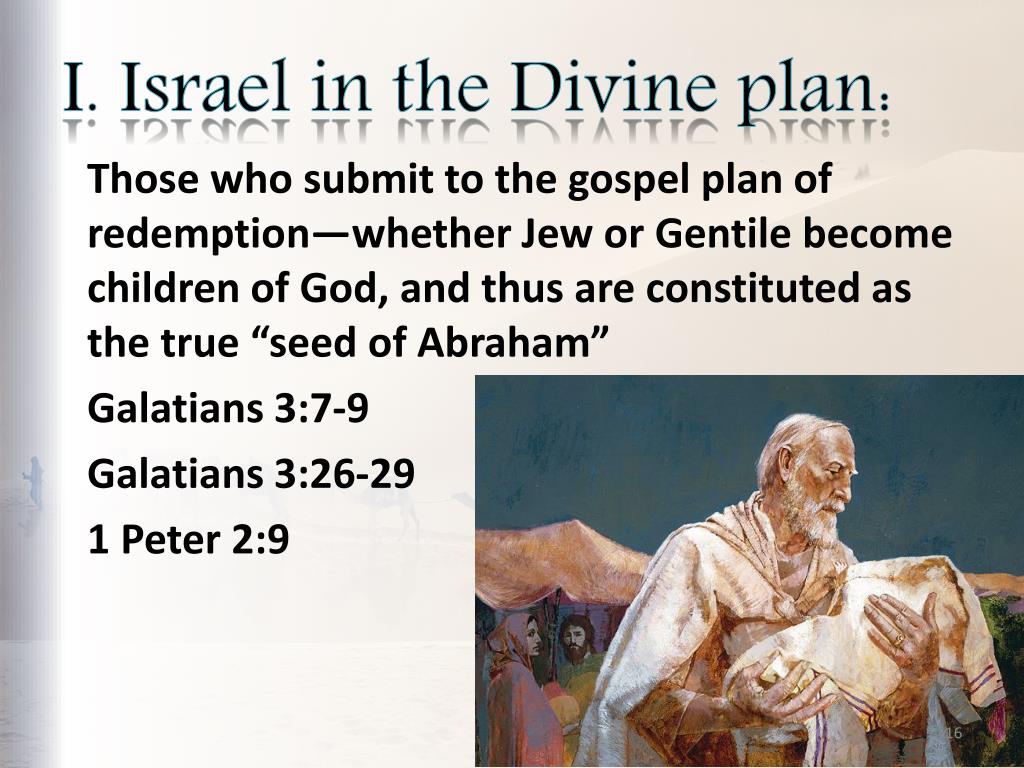
“If you are Christ’s, then you are Abraham’s offspring, heirs according to promise.”
— Galatians 3:29
In Christ, Gentiles and Jews together become the promised family of Abraham, fulfilling God’s plan to bless the nations.
6. What This Means for Us
So what does this “promise and a people” stage show us about God and about ourselves?
- God is a God of promise.
He speaks into a broken world with commitments grounded in His own character. - God works through the unlikely.
An elderly, childless man; a small, enslaved people; a crucified Messiah—this is how He brings salvation. - God’s plan is global.
From the beginning, His aim is to bless “all the families of the earth,” not just one ethnic group. - Jesus stands at the center of it all.
The promises to Abraham find their “Yes” in Christ, and in Him a new family is formed from every tribe, tongue, and nation.
When you read about Abraham, Isaac, Jacob, and Israel, you’re not just reading ancient history; you’re watching the roots of the gospel being planted. You’re seeing God set in motion the plan that will lead, step by step, to Bethlehem, Calvary, and the empty tomb.
7. Where We Go Next
In this second part of our series, we’ve seen that God’s redemptive plan moves forward by:
- Calling Abraham and making covenant promises
- Forming Israel as His special people
- Committing Himself to bless the nations through this chosen line
But how can a sinful people live with a holy God? How can they represent Him to the world when they themselves are unclean?
In the next post, we’ll explore how God gives Israel law, sacrifice, and His own presence—not as an end in themselves, but as shadows pointing forward to Christ.
Next in the series:
Blog 3 – Law, Sacrifice, and Presence: Shadows of a Greater Reality
Other Resources Available:
- FaithAnswersPress.net: Grow in your faith and share your hope with others. Find biblical answers about the Christian faith. VISIT THE SITE NOW
- Download the FAQs of Faith app for easy access to Faith Answers Press LLC websites, answers to spiritual FAQs, and a daily faith-boosting podcast. DOWNLOAD NOW