How Israel’s Throne and God’s Word Point to Jesus
By now in this series we’ve seen:
- Creation and Catastrophe – Why we need a Savior.
- Promise and a People – How God began His rescue through Abraham and Israel.
- Law, Sacrifice, and Presence – How God lived among His people through a system that pointed beyond itself.
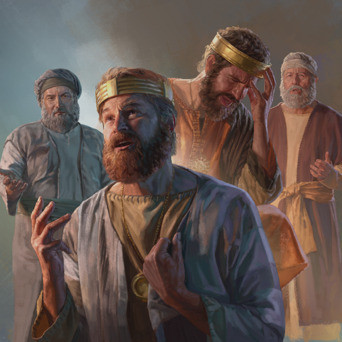
In this fourth part, we come to two of the most visible features of Old Testament life: kings and prophets.
God gives Israel kings to rule and prophets to speak His word. But as the story unfolds, one thing becomes clear: even at their best, the kings can’t bring lasting peace and righteousness, and the prophets keep pointing forward to something—and Someone—greater.
This part of the story creates a deep longing for a perfect Ruler who will combine both the crown and the word of God in Himself. That longing is finally fulfilled in Jesus.
1. “We Want a King”: Israel’s Demand and God’s Response
After Joshua’s death, Israel enters the time of the judges—a dark and chaotic period summarized by a haunting refrain:
“Everyone did what was right in his own eyes.”
— Judges 21:25
Eventually, the people come to the prophet Samuel and demand a king:
“Appoint for us a king to judge us like all the nations.”
— 1 Samuel 8:5
On one level, this isn’t entirely wrong. Back in Deuteronomy 17, God had already anticipated the day Israel would have a king and given laws about how that king should live. God was not against kingship in itself.
But in 1 Samuel 8, their motive is exposed:
- They want to be “like all the nations” (v. 5, 20).
- They are rejecting God as their king (1 Samuel 8:7).
Still, God grants their request—and in doing so He uses even their wrong motives to further His redemptive plan. He will work through the monarchy to prepare the way for His chosen King.
2. Saul and David: False Start and True Pattern
Saul: The King Who Looks the Part
Israel’s first king, Saul, is exactly what the people think they want:
- Tall, impressive, outwardly strong (1 Samuel 9:2).
- A military leader who can “go out before us and fight our battles” (1 Samuel 8:20).
But Saul’s heart is not loyal to the Lord. He disobeys God’s commands, fears people more than God, and refuses genuine repentance (1 Samuel 13, 15). God rejects him as king.
Saul shows us that appearance and charisma are not enough. God is looking for something deeper.
David: A Man After God’s Own Heart
God then chooses David, the youngest son of Jesse, a shepherd boy from Bethlehem. Even Samuel is tempted to judge by appearances, but God corrects him:
“For the LORD sees not as man sees: man looks on the outward appearance, but the LORD looks on the heart.”
— 1 Samuel 16:7
David becomes the great warrior-king who defeats Goliath, unites the tribes, and establishes Jerusalem as Israel’s capital. He is called “a man after [God’s] own heart” (1 Samuel 13:14; Acts 13:22).
Yet David is far from perfect:
- He commits adultery with Bathsheba.
- He arranges the death of her husband, Uriah (2 Samuel 11).
- He fails in his role as a father and ruler at key moments.
David is both model and warning:
- Model – A king who trusts God, loves God’s law, and leads Israel in worship.
- Warning – Even the best human king is stained by sin and unable to bring perfect righteousness.
3. God’s Promise to David: An Eternal Throne
The turning point comes in 2 Samuel 7. David wants to build a house (temple) for God, but God turns it around and promises to build a “house” (dynasty) for David:
“I will raise up your offspring after you, who shall come from your body, and I will establish his kingdom.
He shall build a house for my name, and I will establish the throne of his kingdom forever.
I will be to him a father, and he shall be to me a son.”
— 2 Samuel 7:12–14
This covenant with David includes:
- A royal son from David’s line.
- A kingdom and throne that will last forever.
- A unique father–son relationship between God and the king.
On one level, this points to David’s immediate descendants (like Solomon). But the language of an eternal throne presses beyond any merely human reign.
The rest of the Old Testament keeps coming back to this promise. It’s like a refrain of hope:
- Psalm 2 – A Son installed as King on Zion, ruling the nations.
- Psalm 89 – God swears He will not lie to David: “His offspring shall endure forever, his throne as long as the sun before me” (vv. 35–37).
- Isaiah 9:6–7 – A child is born, a son is given, who will sit “on the throne of David and over his kingdom… from this time forth and forevermore.”
The question becomes: Who is this King?
How can a throne really last forever?
4. The Rise and Fall of the Kings: A Story of Failure
After David and Solomon, the kingdom splits:
- Northern kingdom (Israel) – With its own kings and capital (Samaria).
- Southern kingdom (Judah) – Ruled by David’s descendants from Jerusalem.
Both kingdoms are filled with idolatry, injustice, and unfaithfulness, with only a few bright spots among the kings—mostly in Judah.
The books of 1–2 Kings and 1–2 Chronicles read like a tragic cycle:
- A king does evil → the people follow → God sends warnings → judgment comes closer.
- Even good kings cannot fully reform the nation or change their hearts.
Eventually:
- The northern kingdom is conquered by Assyria (722 BC).
- The southern kingdom is conquered by Babylon (586 BC), Jerusalem is destroyed, and David’s throne appears to be broken.
From a human perspective, the promises to David seem to have failed. But this is exactly where the prophets step in.
5. The Prophets: God’s Messengers and Watchmen
Prophets are not mainly future-tellers; they are God’s covenant prosecutors—calling kings and people back to faithfulness, warning of judgment, and holding out hope.
They have two main roles:
- Forth-telling – Declaring God’s word about the present: exposing sin, calling for repentance, announcing judgment.
- Foretelling – Revealing God’s plans for the future, especially His plan to save.
Again and again, prophets like Isaiah, Jeremiah, Ezekiel, Hosea, Micah, and others:
- Confront kings who abuse power, tolerate idolatry, and oppress the poor.
- Announce that exile is coming as God’s discipline.
- Refuse to let God’s promises die—even in exile.
A Coming King
In the midst of warnings, the prophets speak of a future King:
- Isaiah 9:6–7 – A child called “Mighty God” and “Prince of Peace,” ruling on David’s throne forever.
- Isaiah 11:1–10 – A shoot from the stump of Jesse (David’s father) who judges with righteousness and brings peace even to creation itself.
- Jeremiah 23:5–6 – A righteous Branch from David’s line, called “The LORD is our righteousness.”
This coming King will not repeat the failures of Israel’s kings. He will rule with perfect justice, wisdom, and faithfulness.
A Coming Prophet and New Covenant
The prophets also speak of:
- A greater Prophet like Moses (Deuteronomy 18:15–18).
- A new covenant with God’s law written on hearts and sins truly forgiven (Jeremiah 31:31–34).
- A Suffering Servant who bears the sins of many (Isaiah 52:13–53:12).
The picture sharpens: God’s future King will also be God’s perfect Prophet and the one who brings in the new covenant through suffering.
All of this points beyond any merely human ruler. The prophets are effectively saying: “The kind of king we really need must be more than a man.”
6. Jesus: The Long-Awaited King and Final Prophet
When we reach the New Testament, the opening lines are loaded with Old Testament expectation:
“The book of the genealogy of Jesus Christ, the son of David, the son of Abraham.”
— Matthew 1:1
Right away, Matthew is telling us: This is the promised King from David’s line.
The angels confirm it:
“The Lord God will give to him the throne of his father David, and he will reign over the house of Jacob forever, and of his kingdom there will be no end.”
— Luke 1:32–33
Jesus as King
Throughout the Gospels:
- Jesus announces the arrival of the kingdom of God (Mark 1:15).
- He rides into Jerusalem on a donkey, fulfilling Zechariah’s prophecy of the humble King (Zechariah 9:9; Matthew 21:4–5).
- The charge above His cross reads, “Jesus of Nazareth, the King of the Jews” (John 19:19).
Ironically, it is in His crucifixion—what looks like defeat—that Jesus establishes His kingdom. He conquers not Rome, but sin, death, and Satan.
After His resurrection, He declares:
“All authority in heaven and on earth has been given to me.”
— Matthew 28:18
This is the language of universal kingship. Jesus is the King the prophets longed for—the one whose reign will never end.
Jesus as Prophet
Jesus is also the final and fullest Prophet:
- He is the Word made flesh (John 1:14).
- He speaks not just for God but as God: “You have heard that it was said… But I say to you…” (Matthew 5).
- The crowds recognize Him as a prophet (Matthew 21:11), and the apostles later identify Him as the Prophet like Moses (Acts 3:22–23).
As Prophet, Jesus doesn’t merely relay God’s word; He is God’s definitive Word to humanity (Hebrews 1:1–2).
In Him, the roles of King and Prophet come together perfectly.
7. Why This Matters: Our Hope and Allegiance
The story of Israel’s kings and prophets is not just background information; it shapes how we relate to Jesus today.
- Our deepest hope is not in human rulers.
The failures of Saul, Solomon, and the rest are a warning against putting ultimate trust in any political system or leader. Only Jesus is the perfectly just King. - We need a King who also changes hearts.
Laws and leadership alone could not fix Israel’s rebellion. We need a King who gives new hearts—and Jesus does this through the gift of the Holy Spirit. - We must listen to God’s final Prophet.
God once spoke through many prophets, but now has spoken definitively in His Son (Hebrews 1:1–2). Our response to Jesus’ words is our response to God Himself. - We are citizens of a different kingdom.
If Jesus is David’s greater Son, raised and enthroned, then we belong to a kingdom that cannot be shaken (Hebrews 12:28). Our allegiance, hope, and identity are ultimately found in Him.
8. Looking Ahead
In “Prophets and Kings,” we’ve seen how:
- God established a royal line through David and promised an eternal throne.
- Israel’s kings mostly failed, driving the nation into exile.
- The prophets confronted sin, announced judgment, and held out hope for a coming King and new covenant.
- Jesus steps onto the stage as the son of David, the final Prophet, and the true King.
In the next part of this series, we’ll turn to the Psalms and wisdom books—Israel’s songs and reflections on life, suffering, and righteousness—and see how their deepest longings and questions find their answer in Christ.
Next in the series:
Blog 5 – Wisdom, Worship, and Suffering: Longings Only Christ Can Fulfill
Other Resources Available:
- FaithAnswersPress.net: Grow in your faith and share your hope with others. Find biblical answers about the Christian faith. VISIT THE SITE NOW
- Download the FAQs of Faith app for easy access to Faith Answers Press LLC websites, answers to spiritual FAQs, and a daily faith-boosting podcast. DOWNLOAD NOW