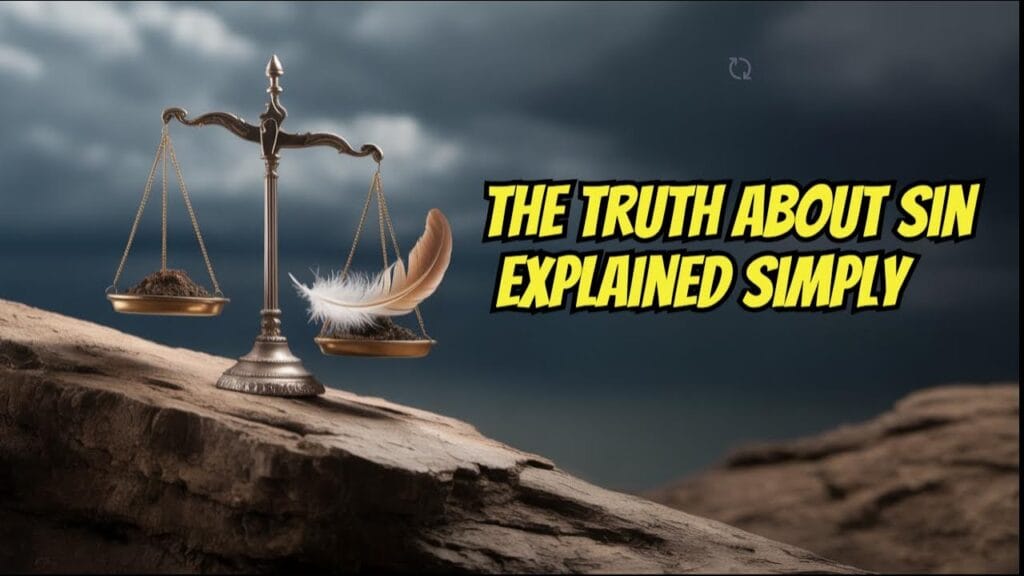
“All we like sheep have gone astray; we have turned—every one—to his own way.” — Isaiah 53:6
“Everyone who makes a practice of sinning also practices lawlessness; sin is lawlessness.” — 1 John 3:4
If Parts 1–3 have shown us that truth is real, that God is holy and truly there, and that human beings were made in His image with dignity and purpose, then a painful question immediately follows:
What Went Wrong?
Why is the world so beautiful and yet so cruel? Why do we long for justice and still lie, envy, lust, rage, and wound one another? Why do we sense that we were made for something higher, yet repeatedly choose what degrades us?
The Bible’s answer is neither flattering nor confused. What went wrong is sin.
Not merely weakness. Not only ignorance. Not just social dysfunction. Not simply trauma, environment, or bad habits. Those things matter, and they can shape our lives deeply. But beneath them all lies something more personal and more serious: we have rebelled against the God who made us.
This is a truth many people resist, because it does not merely diagnose the world “out there.” It diagnoses me.
Sin Is Not Just Brokenness. It Is Rebellion.
Modern people often speak of “brokenness,” and there is some truth in that word. The world is broken. Families are broken. Bodies and minds are broken. But if we stop there, we soften what Scripture makes sharp.
The Bible does not speak of sin merely as damage we suffer; it speaks of sin as guilt we incur.
Sin is not just the fact that we are wounded. It is the fact that we are wrong.
At its core, sin is a refusal to let God be God. It is the heart saying,
“My will be done, not Yours.”
That rebellion shows itself in thought, word, deed, desire, motive, and neglect. We break God’s law not only by doing what He forbids, but by failing to love what He commands.
Jesus said the greatest commandment is to love the Lord our God with all our heart, soul, mind, and strength (Mark 12:29–30). Measured by that standard, sin is not just murder or adultery or theft. Sin is every movement of the soul away from God’s rightful rule.
R.C. Sproul famously called sin “cosmic treason.” That phrase may sound severe, but it helps recover the scale of the problem. Sin is not small because God is not small.
Genesis 3: The First Revolt
To understand sin, we need to go back to the beginning.
Genesis 3 is not a childish myth about a talking serpent. It is God’s own explanation of the human condition. Adam and Eve were made good, placed in fellowship with God, and given His word. Yet the serpent’s temptation struck at the center:
“Did God actually say…?” — Genesis 3:1
The first sin began with distrust of God’s word.
Then came suspicion of God’s goodness:
“For God knows that when you eat of it your eyes will be opened, and you will be like God…” — Genesis 3:5
In other words: God is withholding something good from you. You cannot trust Him. Take autonomy for yourself.
That is still the anatomy of sin today.
We sin because we believe, at some level, that:
- God’s commands are restrictive rather than good.
- God’s warnings are exaggerated rather than true.
- God’s place as Lord is negotiable.
- We will be better off ruling ourselves.
Adam and Eve did not merely eat forbidden fruit. They reached for moral independence. They wanted wisdom on their own terms. They wanted the benefits of Godlikeness without joyful submission to God.
And so do we.
Sin Is Universal
It is always easier to talk about evil in the abstract. We can all point to dictators, abusers, war criminals, corrupt systems, and obvious wickedness. But Scripture refuses to let us stay safely at a distance.
Romans 3 closes the escape route:
“None is righteous, no, not one; no one understands; no one seeks for God.” — Romans 3:10–11
“For all have sinned and fall short of the glory of God.” — Romans 3:23
Not some. All.
That means sin is not merely a feature of especially bad people. It is the shared condition of the human race after the fall. We are not sinners only because we sin; we sin because we are sinners by nature.
This does not mean every person is as evil as possible. By God’s common grace, people can show kindness, courage, loyalty, and self-sacrifice. But even our best moments are not pure enough to erase the deeper problem. We still fall short of God’s glory. We still fail to love Him as He deserves.
Isaiah 53:6 is painfully direct:
“All we like sheep have gone astray; we have turned—every one—to his own way.”
The problem is not only that humanity has gone astray. The problem is that I have gone astray.
John Owen wrote, “Be killing sin or it will be killing you.” He understood that sin is not passive or harmless. It is active, corrosive, and deadly.
The Consequences of Sin
Sin is not a harmless private matter. It tears through every level of life.
1. Separation from God
The deepest consequence of sin is spiritual alienation.
Adam and Eve hid from God after they sinned (Genesis 3:8). Shame entered where fellowship had been. Fear entered where trust had been. The relationship was broken.
This is still true of us. Sin separates us from the God for whom we were made.
“Your iniquities have made a separation between you and your God…” — Isaiah 59:2
A person may feel spiritually curious, moral, or religious and still be estranged from God at the core.
2. Death
God had warned Adam that disobedience would bring death (Genesis 2:17). After sin entered, death entered too.
- Spiritual death: alienation from God now.
- Physical death: the body returning to dust.
- Eternal death: final judgment apart from God’s mercy.
“For the wages of sin is death…” — Romans 6:23
Death is not natural in the ultimate sense; it is an intruder. It is a sign that something has gone terribly wrong.
3. Broken Relationships
The fall shattered human relationships immediately. Adam blamed Eve. Eve blamed the serpent. Harmony gave way to accusation.
We still see the same pattern:
- pride and self-protection
- manipulation and blame-shifting
- lust instead of love
- control instead of service
- suspicion instead of trust
Our horizontal conflicts are rooted in a vertical rupture.
4. Futility and Suffering in the World
Because man’s sin affected the created order, life east of Eden is marked by thorns, pain, frustration, and decay.
“The creation was subjected to futility…” — Romans 8:20
The world still bears traces of glory, but it groans under a curse. Our moral ruin spills into every corner of human experience.
Sin Is Personal Guilt Before a Holy God
One of the most dangerous modern habits is to speak of sin only in therapeutic categories. We talk about wounds, dysfunction, addiction, coping, shame, and patterns. Some of that language can be useful. But if it replaces biblical categories, it becomes misleading.
The primary problem with sin is not that it lowers your self-esteem or disrupts your inner peace. The primary problem is that it is committed against God.
David understood this when he prayed after his terrible sins:
“Against you, you only, have I sinned and done what is evil in your sight…” — Psalm 51:4
That does not mean David had not harmed others. He had. But every sin is first and finally an offense against the God whose law we have broken.
If you miss this, you will misunderstand everything that follows. You may look for healing, improvement, or inspiration. But you will not yet be seeking mercy.
John Stott wrote, “Before we can begin to see the cross as something done for us, we have to see it as something done by us.” That is exactly right. Until sin becomes personal, grace will seem optional and Christ will seem unnecessary.
Common Pitfalls That Can Derail an Honest Search
If you are seriously seeking truth, there are several mistakes you must avoid here.
1. Minimizing Sin
This is the language of, “Nobody’s perfect,” “I’m only human,” or “At least I’m not as bad as some people.”
That may sound humble, but it often functions as an excuse rather than a confession. The issue is not whether you are worse than someone else. The issue is whether you have loved, trusted, and obeyed God as you should.
Comparison with other sinners is a way of hiding from God.
2. Redefining Sin as Only Social Evil
It is true that sin damages societies, systems, and structures. But the Bible will not let us turn sin into something merely external or collective.
It is not enough to condemn greed, injustice, lust, or oppression “out there” while refusing to face envy, pride, impurity, deceit, bitterness, and unbelief within.
The line of sin does not run simply between groups of people. It runs through every human heart.
3. Blaming God
Some say, “If God made me this way, this must be His fault,” or “If He knew what I would do, how can He blame me?”
Those objections may feel sophisticated, but Scripture never allows us to push our moral responsibility back onto our Maker. Genesis 3 shows the ancient instinct to shift blame. Adam blamed Eve—and indirectly God Himself: “the woman whom you gave to be with me” (Genesis 3:12).
Blame-shifting is one of sin’s oldest habits.
4. Treating Sin as Merely Psychological Brokenness
Again, there is real brokenness in the world, and many people have been sinned against terribly. But being sinned against does not erase the fact that we ourselves also sin.
If you view yourself only as wounded, never as guilty, you may seek comfort without repentance.
5. Thinking Honest Conviction Is Harmful
Many people fear that strong language about sin is unhealthy. But false peace is more dangerous than painful truth. A doctor who softens a diagnosis to protect your feelings is not kind.
Thomas Watson wrote, “Till sin be bitter, Christ will not be sweet.” That is not cruelty. It is mercy.
Why Facing Sin Honestly Is Necessary
An honest search for truth cannot stop with “I am flawed.” It must come to, “I am guilty before God.”
That realization is humbling, but it is also necessary. If you will not face the disease, you will never seek the cure. If you insist that your deepest problem is merely confusion, damage, or lack of self-improvement, you will keep reaching for the wrong remedies.
And there are many false remedies:
- religion without repentance
- morality without new birth
- self-help without holiness
- activism without self-examination
- spirituality without submission to God
None of these can solve the real problem, because none of them remove guilt or reconcile rebels to a holy God.
A Hard Truth That Opens the Door to Hope
This is a dark part of the story, but it is not pointless darkness. Scripture exposes sin in order to strip away illusion.
God does not tell us the truth about our sin to amuse Himself by crushing us. He tells us because He means to lead honest sinners to the only real hope.
But we must not run ahead too quickly. Before grace sounds sweet, sin must sound true.
So pause here and ask:
- Have I been minimizing my sin?
- Have I treated evil as something mainly outside me rather than inside me?
- Have I spoken of brokenness while avoiding guilt?
- Have I been blaming others—or even God—for what I myself must own?
The road to repentance begins with honesty. And honesty begins here:
Something is wrong with the world because something is wrong with us. Something is wrong with us because we have turned from God.
That is what went wrong.
In the next part, we must go one step further: if sin is real and God is holy, then what does divine justice require?
Reflection Questions
- When you think about your own life, are you more inclined to minimize, redefine, or excuse your sin?
- In what ways do you see the pattern of Genesis 3—distrusting God, asserting self-rule, and blame-shifting—still operating in your heart?
- Why is it important to see sin not only as brokenness, but as personal guilt before God?
Key Scriptures to Read Again
- Genesis 3:1–19
- Psalm 51:1–4
- Isaiah 53:6
- Romans 3:10–23
- 1 John 3:4
A Brief Prayer
Holy God, I confess that I have often softened what You speak of plainly. I have called sin by gentler names, blamed others, and defended myself. Please give me honesty to see my heart as it really is. Do not let me hide from the truth. Prepare me not only to feel bad about sin, but to turn from it and seek Your mercy on Your terms. Amen.
Other Resources Available:
- FaithAnswersPress.net: Grow in your faith and share your hope with others. Find biblical answers about the Christian faith. VISIT THE SITE NOW
- Download the FAQs of Faith app for easy access to Faith Answers Press LLC websites, answers to spiritual FAQs, and a daily faith-boosting podcast. DOWNLOAD NOW