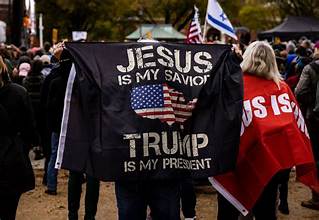
Trading the Cross for a Crown of Politics
In our previous posts, we explored how Progressive Christianity compromises the Gospel by twisting Scripture to align with the political and cultural Left. But spiritual discernment requires us to look in all directions. If the Left offers the danger of Progressivism, the Right offers a different, yet equally dangerous temptation: Christian Nationalism.
Both errors ultimately make the same fundamental mistake. They replace the spiritual mission of the Church with a worldly, political agenda.
Before we dive in, let’s make a crucial distinction. Patriotism is not a sin. Loving your country, honoring those who serve it, praying for its leaders, and voting for just, moral laws are all good and biblical practices (Jeremiah 29:7).
However, Christian Nationalism takes a step further. It is an ideology that merges Christian identity with national identity, subtly teaching that to be a “good American” is to be a “good Christian,” and vice versa. It treats the nation not just as a place where Christians live, but as a “Christian Kingdom” that must be conquered for God.
When we hold this ideology up to the light of Scripture, the cracks quickly begin to show. Here are five key differences between Biblical Christianity and Christian Nationalism.
1. The Location of the Kingdom
Christian Nationalism blurs the lines between the Church and the State. It subtly teaches that the success of the Gospel is tied to the success of a specific geopolitical nation.
Biblical Christianity recognizes a profound truth spoken by Jesus Himself: “My kingdom is not of this world” (John 18:36). The Apostle Paul reminds us that “our citizenship is in heaven” (Philippians 3:20). The Church is a global, spiritual kingdom made up of people from every tribe, tongue, and nation (Revelation 7:9). It has no earthly borders and relies on no earthly constitution.
2. The Misapplication of Scripture
Christian Nationalism frequently takes promises given specifically to the ancient nation of Israel and pastes them onto modern nations. A classic example is 2 Chronicles 7:14: “If my people, who are called by my name, will humble themselves and pray… I will heal their land.” Nationalists apply this to America, treating the U.S. as God’s specially covenanted nation.
Biblical Christianity recognizes that the Old Testament theocracy of Israel was entirely unique. Under the New Covenant, God’s “chosen people” is not a country; it is the Church. Treating America—or any other modern nation—like Old Testament Israel leads to a dangerous misinterpretation of the Bible.
3. The Primary Mission
Christian Nationalism believes the primary way to transform culture is from the top-down—by acquiring political power, passing legislation, and enforcing Christian morality on the populace. The ultimate goal is cultural dominance.
Biblical Christianity believes true transformation happens from the bottom-up, through the regenerating power of the Gospel. Our primary mission is the Great Commission (Matthew 28:19-20)—preaching the Gospel and making disciples. While Christians absolutely should advocate for righteous laws, we know that legislation can only restrain outward behavior; it cannot resurrect a dead heart.
4. The Object of Worship
Christian Nationalism often fuses national symbols with sacred symbols. The American flag and the Cross become almost indistinguishable in the sanctuary. When ultimate devotion is given to a nation, it borders on idolatry.
Biblical Christianity honors earthly authorities (Romans 13) but keeps absolute allegiance reserved for Christ alone. A biblical Christian knows that empires rise and fall, but the Word of God endures forever. We must never reduce the King of Kings to a political mascot for a partisan agenda.
5. The Weapons of Warfare
Christian Nationalism relies heavily on worldly methods—anger, political maneuvering, intimidation, and the “Sword of the State”—to ensure Christian values rule the public square.
Biblical Christianity relies on the “Sword of the Spirit,” which is the Word of God. As the Apostle Paul writes, “For the weapons of our warfare are not of the flesh but have divine power to destroy strongholds” (2 Corinthians 10:4). We conquer not by destroying our cultural enemies, but by loving them, serving them, and preaching Christ crucified.
Conclusion: A Church Unshackled
It can be terrifying to watch a culture drift away from biblical values. The temptation to grab the reins of political power to “save” the nation is incredibly strong.
But we must remember: the Gospel does not need the government’s help to survive.
The early Church turned the entire Roman Empire upside down (Acts 17:6). They didn’t achieve this by holding political office, waving flags, or demanding cultural dominance. They did it by boldly preaching the resurrection of Jesus Christ, loving their neighbors, and living holy lives, even to the point of martyrdom.
Whenever the Church marries the State, the Church eventually becomes the subservient spouse. By guarding against Christian Nationalism, we keep the Cross central and our eyes fixed on the only Kingdom that will never fade away.
Other Resources Available:
- FaithAnswersPress.net: Grow in your faith and share your hope with others. Find biblical answers about the Christian faith. VISIT THE SITE NOW
- Download the FAQs of Faith app for easy access to Faith Answers Press LLC websites, answers to spiritual FAQs, and a daily faith-boosting podcast. DOWNLOAD NOW