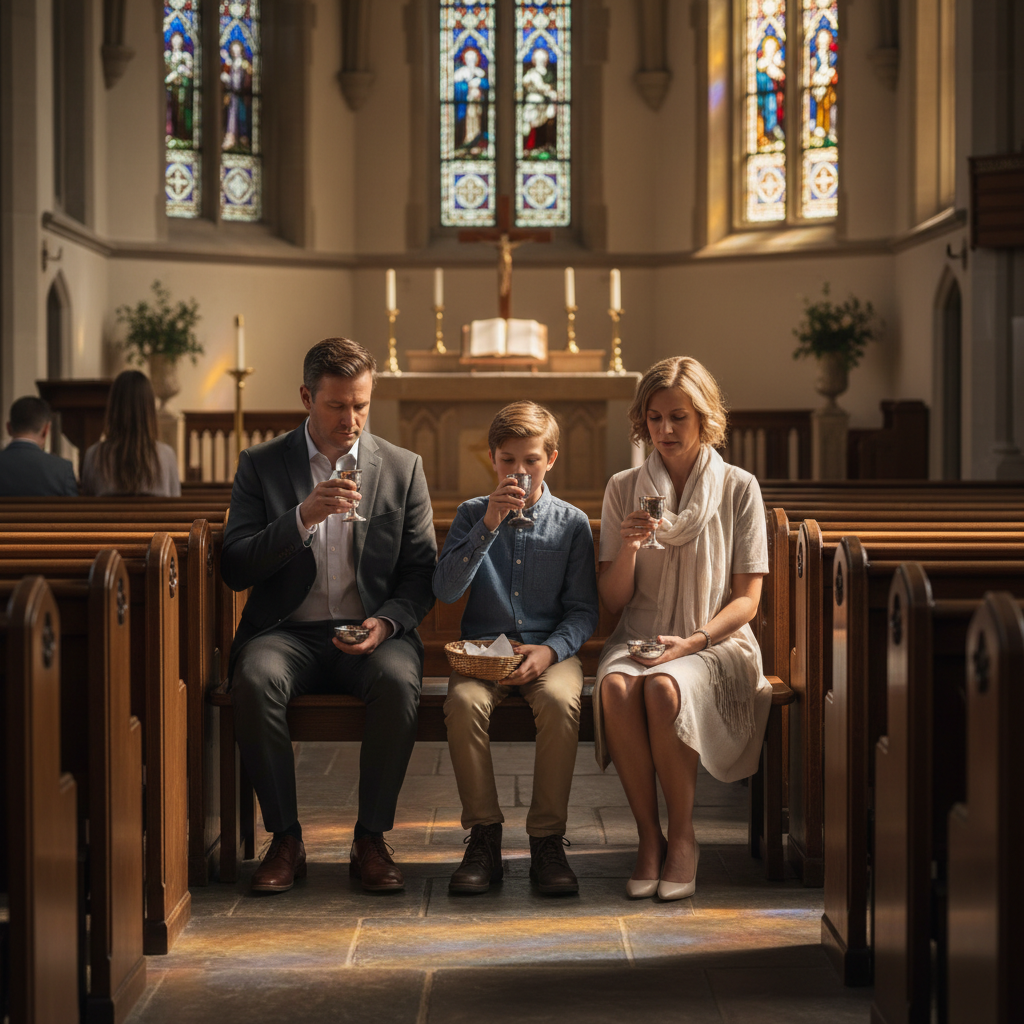
Communion—also called the Lord’s Supper or the Eucharist—is one of the most sacred practices Christ gave to His church. It is simple in its elements, bread and the cup, yet profound in its meaning. In communion, believers remember the sacrifice of Jesus Christ, proclaim His saving death, confess their dependence on Him, and look forward to His return.
From the upper room to the gathered church today, communion has stood at the heart of Christian worship. It is not an empty ritual. It is a Christ-centered act of remembrance, thanksgiving, fellowship, self-examination, and hope.
The Biblical Basis of Communion
The historical foundation of communion is found in the final meal Jesus shared with His disciples on the night He was betrayed. The Gospels record that during the Passover meal, Jesus took bread, gave thanks, broke it, and gave it to His disciples, saying, “This is my body, which is given for you. Do this in remembrance of me” (Luke 22:19). He also took the cup and said, “This cup that is poured out for you is the new covenant in my blood” (Luke 22:20).
Matthew 26:26–29, Mark 14:22–25, and Luke 22:14–20 all preserve this institution of the Supper. The apostle Paul later confirms the same teaching in 1 Corinthians 11:23–26, where he says he received this instruction from the Lord and delivered it to the church.
Communion is therefore not a later church invention. It comes directly from Jesus Himself. It is rooted in the Old Testament Passover, fulfilled in Christ, and handed down to the church as an ongoing ordinance or sacrament.
Why Communion Matters
Communion matters because Christ commanded it. That alone makes it precious and necessary for the church. But Scripture shows several additional reasons it is vital.
First, communion keeps the gospel before us. The bread and cup visibly preach Christ crucified. They remind believers that salvation rests not in human effort but in the broken body and shed blood of Jesus.
Second, communion strengthens the church’s fellowship with Christ and with one another. Paul writes, “The cup of blessing that we bless, is it not a participation in the blood of Christ? The bread that we break, is it not a participation in the body of Christ?” (1 Corinthians 10:16). The Supper is not merely private reflection; it is a shared act of covenant fellowship.
Third, communion calls believers to regular self-examination, repentance, and renewed faith. It invites us to come honestly before the Lord, turning from sin and clinging again to Christ.
Fourth, communion directs our eyes forward. Jesus spoke of a future day when He would drink the fruit of the vine anew in the kingdom of God (Mark 14:25). The Lord’s Table is not only remembrance of the cross but anticipation of the marriage supper of the Lamb.
The Symbolism of the Bread and the Cup
The symbolism of communion is rich and deeply biblical.
– The Bread
The bread signifies the body of Christ given for His people. It points to the incarnation—God the Son taking on flesh—and to His sacrificial offering on the cross. When the bread is broken, believers are reminded that Christ willingly gave Himself for sinners.
– The Cup
The cup signifies the blood of Christ, shed for the forgiveness of sins and the establishing of the new covenant. Just as covenants in Scripture were often ratified by blood, so the new covenant is secured by the blood of Jesus, the true and final sacrifice.
– Remembrance and Proclamation
Jesus explicitly said, “Do this in remembrance of me.” This remembrance is not mere mental recall, as though believers are simply thinking about a distant event. It is an active, worshipful remembering in which the church proclaims the Lord’s death until He comes (1 Corinthians 11:26).
– Unity
Because believers partake of one bread, communion also symbolizes the unity of the body of Christ. Though many, the church is one in Him (1 Corinthians 10:17).
Biblical Instruction for Practicing Communion
Scripture gives clear instruction for the practice of communion.
Jesus commanded His disciples to continue observing it. Paul shows that the church did so when gathered together. Though the New Testament does not prescribe an exact frequency, it makes clear that communion belongs to the regular life of the church.
Several principles stand out:
- Communion is to be centered on Christ and His atoning work.
- It is to be received with thanksgiving, faith, and reverence.
- It is to be observed by the gathered church.
- It is to be accompanied by self-examination.
- It is to reflect the unity and holiness of Christ’s people.
Paul’s teaching in 1 Corinthians 11 is especially important because it corrects an abusive practice. The Corinthians were treating the meal selfishly, humiliating the poor, and failing to discern its sacred meaning. Paul calls them back to a worthy manner of partaking.
Biblical Warnings Concerning Communion
Communion is a means of grace and blessing, but Scripture also issues serious warnings.
In 1 Corinthians 11:27–29, Paul says that whoever eats the bread or drinks the cup of the Lord in an unworthy manner will be guilty concerning the body and blood of the Lord. He urges each person to examine himself before eating and drinking, “For anyone who eats and drinks without discerning the body eats and drinks judgment on himself.”
These warnings do not mean believers must be sinless before coming to the Table. If that were the standard, no Christian could ever partake. Rather, they mean we must come humbly, repentantly, and with true faith in Christ—neither mocking the ordinance nor treating it casually.
Believers should therefore come with confession of sin, reconciliation where possible, and gratitude for the mercy of God. The Table is not for proud presumption, but neither is it meant to drive away the penitent. It is for those who know they need Christ.
Historical Practice in the Early Church
The early church devoted itself to the apostles’ teaching, fellowship, the breaking of bread, and prayers (Acts 2:42). “Breaking bread” may include ordinary meals in some contexts, but it also reflects the church’s communal worship and remembrance of Christ.
Very early in Christian history, communion became a central feature of Lord’s Day worship. The church understood it as a sacred meal instituted by Christ and tied to His death and resurrection. Over time, Christian traditions developed different theological explanations and liturgical forms, but the Supper remained a defining mark of Christian worship.
Different Methods of Practice
Churches today practice communion in different ways.
Some serve unleavened bread; others use ordinary bread. Some distribute a common cup; others use individual cups. Some receive communion weekly, others monthly or quarterly. Some invite all professing Christians to partake, while others limit participation more narrowly according to church membership or denominational teaching.
These differences matter, but they are not all of equal importance. The main biblical concern is that communion be practiced faithfully, reverently, and in submission to Christ’s word.
Roman Catholic and Protestant Perspectives
Christians agree that communion is holy and Christ-given, but they do not all interpret its nature in the same way.
– Roman Catholic Perspective
In Roman Catholic theology, communion is commonly called the Eucharist. The Catholic Church teaches that in the Mass, the bread and wine become the body and blood of Christ in substance, even though their outward appearance remains the same. This doctrine is known as transubstantiation.
Roman Catholics do not believe they are repeating Christ’s sacrifice in a crude sense, as though He dies again. Rather, they understand the Mass as a sacramental re-presentation of the one sacrifice of Christ, made present to the worshiper in a unique way. For Catholics, the Eucharist is therefore not only symbolic remembrance but the true, real presence of Christ, received sacramentally.
Because of this view, the Eucharist occupies a central and uniquely elevated place in Roman Catholic worship, devotion, and theology.
Protestant Perspectives
Protestants affirm the institution of communion by Christ and its continuing importance, but they reject the Roman Catholic doctrine of transubstantiation. Protestants also typically reject the understanding of the Mass as sacrificial in the Roman Catholic sense, emphasizing that Christ’s sacrifice was offered once for all (Hebrews 10:10–14).
However, Protestants are not all identical in their interpretation.
Some, such as many Lutherans, affirm a real presence of Christ in the Supper, though not in the Roman Catholic framework of transubstantiation.
Some in the Reformed tradition teach that Christ is truly present spiritually, and that believers genuinely commune with Him by faith through the Holy Spirit.
Others, especially in many Baptist and free church traditions, emphasize communion primarily as a symbolic memorial ordinance that powerfully remembers Christ’s death and strengthens faith, but does not involve Christ’s bodily presence in the elements.
Despite these differences, most Protestants agree on several points: communion was instituted by Christ, belongs to the gathered church, proclaims the gospel, and should be received with faith, reverence, and self-examination.
A Pastoral Word to Believers
If you belong to Christ, do not treat communion as a mere routine. Come thoughtfully. Come gratefully. Come humbly. Come remembering that the Son of God loved you and gave Himself for you.
At the same time, do not stay away merely because you feel weak. Communion is not a reward for the strong; it is nourishment for needy believers. If you are trusting in Christ, repenting of sin, and seeking His mercy, come to the Table with reverence and joy.
The bread and the cup do not save us—Christ saves us. Yet these signs are precious gifts from our Savior. Through them, He turns our attention again to His finished work, unites His people in worship, and strengthens faith in hearts that often grow tired.
Conclusion
Communion is one of Christ’s greatest gifts to His church. It is grounded in history, rich in symbolism, governed by biblical instruction, and surrounded by holy warning. It calls the believer to remember the cross, examine the heart, embrace the gospel, and hope in the coming kingdom.
Whether one speaks of communion, the Lord’s Supper, or the Eucharist, every faithful Christian should approach this ordinance with seriousness, gratitude, and love for Christ.
So when the bread is broken and the cup is given, receive them with faith. Remember His body given for you. Remember His blood shed for you. Proclaim His death until He comes. And come to the Lord’s Table not as one who has no need, but as one who knows that Jesus Christ is enough.
Key Scripture References
- Matthew 26:26–29
- Mark 14:22–25
- Luke 22:14–20
- Acts 2:42
- 1 Corinthians 10:16–17
- 1 Corinthians 11:23–32
- Hebrews 10:10–14
- Revelation 19:9
Other Resources Available:
- FaithAnswersPress.net: Grow in your faith and share your hope with others. Find biblical answers about the Christian faith. VISIT THE SITE NOW
- Download the FAQs of Faith app for easy access to Faith Answers Press LLC websites, answers to spiritual FAQs, and a daily faith-boosting podcast. DOWNLOAD NOW