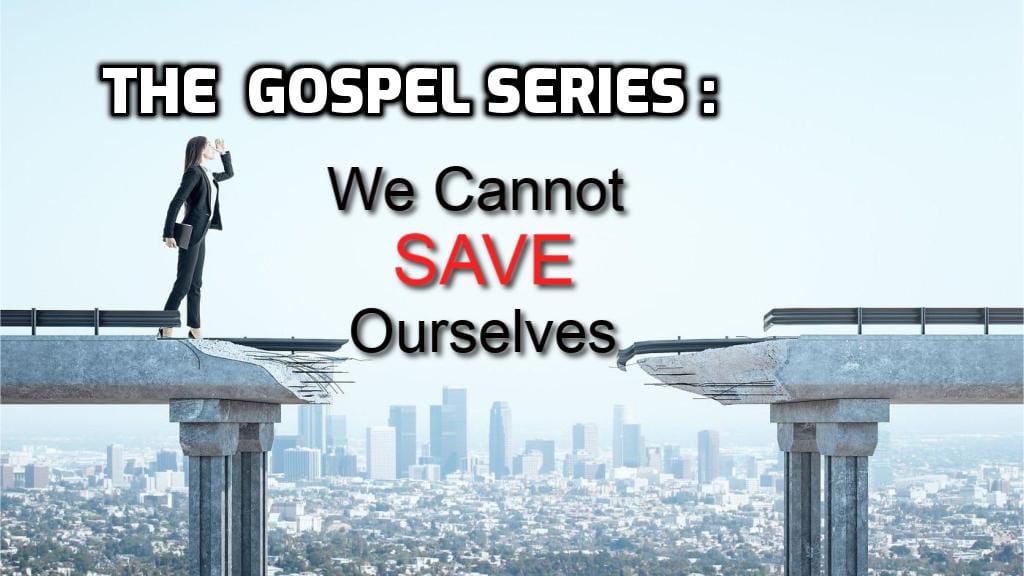
How Can a Guilty Person be Made Right with God?
If God is holy, if sin is real, and if judgment is coming, then one question presses itself upon us with great force: How can a guilty person be made right with God?
Many people answer that question instinctively and confidently: Try harder. Do better. Clean yourself up. Become more religious. Turn over a new leaf. Make up for your past. Be sincere. Be kind. Be moral. God will understand.
That sounds reasonable to fallen human hearts. It also sounds hopeful—at first. But it is not the hope the Bible gives. In fact, it is a false hope. Scripture does not teach that man is basically well and in need of improvement. It teaches that man is spiritually dead and in need of resurrection. It does not say we are merely wounded and require assistance. It says we are enslaved, guilty, corrupt, and unable to rescue ourselves.
This is one of the hardest truths for proud sinners to accept. Yet until we accept it, we will not understand grace, and until we understand grace, we will not come to Christ as needy sinners. The bad news must be faced honestly if the good news is to be received gladly.
Our Natural Religion: Saving Ourselves
From the beginning, fallen man has tried to solve his guilt apart from humble trust in God. After Adam and Eve sinned, they immediately tried to cover themselves with fig leaves (Genesis 3:7). That is humanity in miniature. We know something is wrong. We know we are exposed. We know we are not what we ought to be. And so we begin sewing moral fig leaves.
Some people try to cover themselves with decency. Others with religion. Others with activism, discipline, generosity, family devotion, church attendance, education, or spiritual experiences. Some try to silence their consciences by comparing themselves to worse people. Some hope that their good deeds will outweigh their bad ones. Some assume that if they are sincere, God will overlook the rest.
But sincerity does not erase guilt. Improvement does not cancel rebellion. Religious activity does not create a clean heart. A criminal is not acquitted because he became polite after the crime. In the same way, a sinner is not justified before God because he became more respectable.
The Bible exposes several common self-salvation myths:
- “I’m basically a good person.”
- “Nobody’s perfect, and God knows I’m trying.”
- “God will grade on a curve.”
- “If my good outweighs my bad, I’ll be fine.”
- “If I become more religious, God will accept me.”
- “I can change myself deeply enough to become worthy of mercy.”
These ideas are widespread because they flatter human pride. They allow us to remain our own saviors. And there’s another one — the plea that we simply didn’t know. But as I’ve written in Why God Does Not Excuse the Ignorance of the Gospel, ignorance is not the safe harbor we imagine it to be.
The Bible’s Diagnosis Is Far Worse Than We Think
Scripture does not flatter us. It tells the truth.
Paul writes that we were “dead in the trespasses and sins” in which we once walked (Ephesians 2:1). Dead—not merely weak, confused, or underperforming. Spiritually dead people do not revive themselves. They do not cooperate in their resurrection. They need God to act.
Paul also says that before God saved us, we were “foolish, disobedient, led astray, slaves to various passions and pleasures” (Titus 3:3). Jesus says plainly, “Everyone who practices sin is a slave to sin” (John 8:34). Slaves do not free themselves by wishing harder.
And Romans 8:7–8 goes even deeper: “For the mind that is set on the flesh is hostile to God, for it does not submit to God’s law; indeed, it cannot. Those who are in the flesh cannot please God.” Notice the words: hostile, does not submit, cannot please God. The problem is not merely that we have done bad things; it is that our whole moral posture toward God is wrong apart from grace.
Jeremiah puts it memorably: “Can the Ethiopian change his skin or the leopard his spots? Neither can you do good who are accustomed to doing evil” (Jeremiah 13:23). The point is not that man never does relatively kind or socially useful things. The point is that fallen man cannot, by his own power, change his sinful nature or produce the kind of righteousness that reconciles him to God.
Our Best Works Cannot Remove Our Guilt
People often imagine salvation as a moral balancing scale. On one side are our sins; on the other, our good deeds. The assumption is that God will weigh both and accept the better total.
That is not how divine justice works.
Isaiah 64:6 says, “We have all become like one who is unclean, and all our righteous deeds are like a polluted garment.” Even our “righteous deeds” are stained when offered as grounds of acceptance before a holy God. Why? Because they do not proceed from a perfectly pure heart, nor are they sufficient to undo past guilt.
Suppose a man has told lies, indulged lust, harbored hatred, ignored God, profaned His name, broken His commands, and lived for himself. Can future kindness erase past rebellion? Can charity reverse guilt? Can religious performance undo an offended holiness? No. Good deeds may be good in a relative, horizontal sense, but they cannot function as payment for sin.
Romans 3:20 states it plainly: “By works of the law no human being will be justified in his sight.” Not some people. No human being.
Again, Galatians 2:16 says, “By works of the law no one will be justified.” Scripture repeats this because human hearts resist it.
J. C. Ryle wrote, “You may strive to be better, and yet never be changed. You may alter your habits, and yet never be converted.” That is exactly the issue. Outward reform is not the same as reconciliation to God.
Religion Itself Can Become a Trap
At this point some may object: But surely religion helps. Surely God is pleased if I become more devout.
Religion, in one sense, can restrain outward sin. It can teach order, seriousness, and even biblical vocabulary. But religion without regeneration can become one of the most dangerous refuges from the living God.
Jesus’ sharpest rebukes were not aimed at open pagans, but at self-righteous religious men. In Luke 18:9–14, Jesus tells of a Pharisee who stood confidently before God, rehearsing his moral achievements, and a tax collector who stood far off, beat his breast, and cried, “God, be merciful to me, a sinner!” Jesus says it was the broken sinner, not the proud religionist, who went down to his house justified.
Why? Because the Pharisee trusted in himself that he was righteous. He used religion not to come to God empty-handed, but to present a case for his own worthiness.
This danger has not gone away. A man can read theology, attend church, oppose cultural sins, defend orthodoxy, give money, and clean up his life while remaining a stranger to grace. He may become harder, not softer. He may become more confident in himself, not more dependent on Christ.
Charles Spurgeon warned, “Morality may keep you out of jail, but it takes the blood of Jesus Christ to keep you out of hell.” That is blunt, but true. External respectability is not new birth.
The Problem Is Not Merely What We Have Done, but What We Are
Many people view salvation as though God merely needs to tidy up our record. But if Scripture is true, our need is deeper than pardon alone. We need cleansing, yes—but also a new heart. We need forgiveness—but also life.
David prays in Psalm 51:10, “Create in me a clean heart, O God, and renew a right spirit within me.” He does not ask merely for improved habits. He asks for a creative act of God.
Ezekiel 36:26 records God’s promise: “And I will give you a new heart, and a new spirit I will put within you.” That is what salvation requires. Not self-editing, but divine re-creation.
Jesus told Nicodemus, a highly religious man, “Unless one is born again he cannot see the kingdom of God” (John 3:3). Not “unless one becomes more serious.” Not “unless one adds spiritual discipline.” But “unless one is born again.” Birth is not self-produced.
This is why self-salvation fails at every level:
- It cannot remove guilt.
- It cannot satisfy justice.
- It cannot change the heart.
- It cannot defeat slavery to sin.
- It cannot produce perfect righteousness.
- It cannot survive the scrutiny of God’s holiness.
The Law Can Expose Us, but It Cannot Save Us
God’s law is holy, righteous, and good (Romans 7:12). But the law was never given as a ladder by which sinners climb into favor with God. It reveals God’s character, exposes our sin, and shuts our mouths.
Romans 3:19–20 says that through the law comes “knowledge of sin.” The law is like a mirror. It shows the dirt on your face, but it cannot wash you. It can diagnose the disease, but it cannot cure it.
If a man thinks Christianity is mainly about commands to obey so that God will finally accept him, he has not yet understood Christianity. The law tells him what righteousness is. It does not give him the power to become righteous, nor does it pardon the guilt he already bears.
Martin Luther said, “The law says, ‘Do this,’ and it is never done. Grace says, ‘Believe in this,’ and everything is already done.” That does not make the law unimportant. It means the law cannot function as our savior.
Why “Trying Your Best” Is Not Enough
One of the most common refuges from conviction is the phrase, I’m doing my best. But the real question is not whether you are doing your best by your own standards. The real question is whether you have loved the Lord your God with all your heart, soul, mind, and strength, and loved your neighbor as yourself—always, perfectly, without mixture of pride, selfishness, or unbelief.
No honest person can claim that.
And even if from this day forward you were better than before, what would become of all the sins already committed? The debt remains. The stain remains. The verdict remains.
To say “I’m trying my best” is often just a more polite way of saying, “I hope God will lower the standard.” But God does not lower the standard of His own holiness.
Why Despair Is Also a False Path
There is another error on the opposite side. Some hear that they cannot save themselves and conclude, Then there is no hope for me. That too is a mistake.
The point of this doctrine is not to drive you into hopelessness, but to drive you out of self-trust. Scripture shuts the door on self-salvation so that it may open the door of grace.
Ephesians 2 does not stop with death; it goes on to say, “But God, being rich in mercy, because of the great love with which he loved us… made us alive together with Christ—by grace you have been saved” (Ephesians 2:4–5). Titus 3 does not stop with slavery and foolishness; it continues, “he saved us, not because of works done by us in righteousness, but according to his own mercy” (Titus 3:5).
The sinner’s hope is not that he can climb to God. It is that God, in mercy, comes to save sinners.
John Newton captured this beautifully: “I am not what I ought to be, I am not what I wish to be, I am not what I hope to be; but still I am not what I once used to be, and by the grace of God I am what I am.” Newton understood both ruin and grace.
The Grace We Need Must Come From Outside Ourselves
If we cannot save ourselves, then salvation must come from outside us. It must come from God.
This is one reason the gospel is such good news. It is not advice about how to rescue yourself. It is news about what God has done for helpless sinners.
We need a righteousness we do not possess. We need a sacrifice we could never offer. We need mercy we do not deserve. We need a Redeemer strong enough to do for us what we could never do for ourselves.
Jonah 2:9 says, “Salvation belongs to the Lord.” Entirely. Decisively. Gloriously.
If salvation belonged partly to the Lord and partly to us, then the weak, the failing, the dying, and the burdened would have no solid hope. But if salvation belongs to the Lord, then there is hope even for the chief of sinners.
Jonathan Edwards wrote, “You contribute nothing to your salvation except the sin that made it necessary.” That statement can be stated more sharply than some prefer, but it makes the central point: grace is grace only when God gets the credit.
Common Pitfalls That Can Derail You
1. Moralism
Moralism turns Christianity into “be a better person.” It may use biblical language while emptying the gospel of its heart. It treats Jesus as an example more than a Savior. It offers improvement instead of new birth.
2. Legalism
Legalism imagines that God’s favor can be earned, maintained, or increased by human performance. It can appear strict and serious while quietly denying grace. It always breeds either pride or despair.
3. Religious Self-Deception
A man may be orthodox in words, busy in church, and admired by others while still trusting in himself. Religious familiarity can make a person harder to awaken because he assumes he is safe.
4. Comparison
Comparing yourself with other sinners is useless. The standard is not your neighbor. The standard is God’s holiness.
5. Self-Improvement Spirituality
Modern culture loves the language of growth, healing, optimization, and personal transformation. Some of that language may describe real changes at a human level, but none of it can replace regeneration, justification, and reconciliation with God.
6. Despair
When conviction deepens, despair whispers that your case is exceptional and beyond remedy. But despair is unbelief wearing dark clothes. The gospel is for the ungodly, the guilty, and the helpless.
What Then Should You Do?
Stop trying to present God with a better version of yourself as though that could settle the matter.
Stop bargaining.
Stop comparing.
Stop hiding behind religion, sincerity, good intentions, or future plans.
Agree with God about your condition. Confess that you are not merely flawed but guilty, not merely weak but unable. Ask Him for mercy. Ask Him to do what you cannot do.
The call of the gospel is not, “Make yourself savable.” The call is to come as the sinner you are to the Savior God has provided.
As Robert Murray M’Cheyne famously said, “For every look at yourself, take ten looks at Christ.” That is wise counsel, especially here. Looking honestly at yourself matters—but only if it leads you away from yourself and toward the One who saves.
A Necessary Bridge to the Next Question
If we cannot save ourselves, then the next question is unavoidable: Who can save us?
If morality cannot save, if religion cannot save, if effort cannot save, if tears cannot save, if self-repair cannot save, then we need a Savior from outside ourselves—one appointed by God, sufficient for sinners, able to bear our guilt, satisfy divine justice, and bring us to God.
That is where this series must go next. The hopelessness of self-salvation is not the end of the road. It is the end of pride. And that is a mercy, because proud sinners do not cling to Christ. Needy sinners do.
Key Scriptures to Read and Meditate On
- Ephesians 2:1–9 — Dead in sin, saved by grace.
- Titus 3:3–7 — Not because of works done by us in righteousness.
- Romans 3:19–28 — No one justified by works of the law.
- Romans 8:7–8 — The flesh cannot submit to God or please Him.
- John 3:1–8 — You must be born again.
- Luke 18:9–14 — The Pharisee and the tax collector.
- Isaiah 64:6 — Our righteous deeds cannot justify us.
- Jonah 2:9 — Salvation belongs to the Lord.
Reflection Questions
- In what ways have you been trying to make yourself acceptable to God?
- Do you think of yourself as spiritually weak, or spiritually dead apart from grace?
- Are you trusting in morality, religion, sincerity, comparison, or effort?
- Have you confused outward reform with inward regeneration?
- If salvation truly belongs to the Lord, are you willing to stop defending yourself and ask for mercy?
Final Warning and Invitation
Do not soften this truth into something more flattering. If you do, you will remain trapped in one of the oldest lies in the world—that fallen man can fix himself.
And do not turn this truth into despair. God wounds pride in order to heal sinners. He empties our hands so that we may receive Christ.
You cannot save yourself. But that does not mean there is no salvation. It means salvation must be grace.
And grace is exactly what guilty sinners need.