
The Bible teaches that there is only one way to be saved from God’s wrath. We are saved by grace not by works. Anyone who relies on his works to gain God’s favor is actually under the curse of God’s law. The law was intended to show us that sinners can’t keep His law. When we despair in our own efforts, we open ourselves up to discover the beauty of God’s grace. We can do nothing to earn it, and once we have it, we can do nothing to fall out of it.
The apostle Paul placed no confidence in his own goodness
Most of the people in the world believe they will attain eternal life by living a good life. Paul once thought so too. He had accumulated one of the most impressive records of religious heritage and achievement among the Jews. If anyone should be able to open the doors of the kingdom of God by their credentials, it would surely be Paul. But when he encountered the risen Lord on his way to persecute Christians in Damascus, his perspective was turned upside down.
Paul writes, “If someone else thinks they have reasons to put confidence in the flesh, I have more: circumcised on the eighth day, of the people of Israel, of the tribe of Benjamin, a Hebrew of Hebrews; in regard to the law, a Pharisee; as for zeal, persecuting the church; as for righteousness based on the law, faultless.
“But whatever were gains to me I now consider loss for the sake of Christ. What is more, I consider everything a loss because of the surpassing worth of knowing Christ Jesus my Lord, for whose sake I have lost all things. I consider them garbage, that I may gain Christ” (Philippians 3:4-8).
He discovered that salvation is by grace through faith. It has nothing to do with what you have received by way of heritage, it has nothing to do with human effort or religious duties, but it has everything to do with Christ.
The Jews relied on their own righteousness for salvation
Paul lamented his fellow Israelites’ rejection of Jesus Christ, their Messiah. His heart’s desire and prayer was that they would be saved. In his letter to the saints at Rome, Paul explained why the Jews rejected his central message that we are saved by faith in Christ, not be our works.
Paul wrote, “… the people of Israel, who pursued the law as the way of righteousness, have not attained their goal. Why not? Because they pursued it not by faith but as if it were by works. They stumbled over the stumbling stone… I can testify about them that they are zealous for God, but their zeal is not based on knowledge. Since they did not know the righteousness of God and sought to establish their own, they did not submit to God’s righteousness” (Romans 9:31-32, 10:2).
They were ignorant of how holy God was. They didn’t know how absolutely pure and intolerant of sin He was. So, they conceived of a God who was less holy than He truly is, and they made themselves out to be more holy than they actually were. Therefore, they imagined they could meet God’s holy standards by their own perceived self-righteousness. God’s standard damns the soul of man since His standard is nothing less than perfection.
Submitting to laws and customs for salvation is condemned
As the church in Galatia was getting started, a group of Jewish Christians, known as the Judaizers, were spreading a different gospel that Paul said was really no gospel at all. They argued that faith in Christ alone was insufficient by itself to save anyone. Instead, they taught that in order for a Christian to be truly right with God, he must conform to the Mosaic Law. Circumcision, especially, was promoted as necessary for salvation. Gentiles had to become Jewish proselytes first, and then they could come to Christ.
To counter this pernicious lie, Paul wrote, “For all who rely on the works of the law are under a curse, as it is written: ‘Cursed is everyone who does not continue to do everything written in the Book of the Law.’ Clearly no one who relies on the law is justified before God, because ‘the righteous will live by faith.’ The law is not based on faith; on the contrary, it says, ‘The person who does these things will live by them'” (Galatians 3:10-12).
The point is that if someone is going to trust, even in part, in his ability to keep God’s law for salvation, he would have to obey it perfectly. This is impossible for sinful man to do, and it detracts from what Jesus accomplished for us on the cross.
St. Augustine prevails over Pelagius’ view of man’s free will
St. Augustine is widely regarded as “perhaps the most significant Christian thinker after Paul”1https://www.britannica.com/biography/Saint-Augustine. Like the apostle Paul, he taught that human beings cannot attain righteousness by their own efforts and are totally dependent upon the grace of God.
Pelagius objected to the theological implications of Augustine’s prayer, in which he said, “O God, command what you will and give what you command.” The prayer’s meaning was for God to command whatever He wants and for Him to grant the grace needed to obey His commands. Pelagius believed God would not command believers to do the impossible, and therefore it must be possible to satisfy all divine commandments.
Pelagius claimed that Adam’s sin did not affect the rest of humanity. This countered Augustine’s teachings that humanity was totally depraved in his very nature due to Adam’s sin. He rejected the notion that people are born corrupt and sin because of their own fallen nature. He taught that people are like Adam when he was created; they can sin because of free will. Pelagianism emphasizes a person’s responsibility for their own sinful nature. According to this view, people are not lost in their sin, but rather they have the ability to control themselves. Although a person could theoretically live a sinless life, in practice nobody does.
Pelagius’ antibiblical views were decisively condemned by the church at the 418 Council of Carthage. However, they still maintain a popular following among liberal religious institutions.
The controversy over works between Catholics and Protestants
There is a fundamental difference between the Roman Catholic view of righteousness and the Protestant view. For the Roman Catholic, the believer is made righteous by his or her cooperating with God’s grace. For the Protestant, the believer is declared righteous when he comes to faith, based on the righteousness of Christ credited (imputed) to him.
The Roman Catholic doctrine of infused righteousness
Infused righteousness2 article from https://www.theopedia.com/infused-righteousness refers to the Roman Catholic doctrine of Justification, i.e. right standing before God. Within the Roman Catholic view, Justification is seen as a “process” as contrasted to the Protestant view of a moment-in-time forensic declaration by God that the sinner is righteous. The instrumental cause of infused righteousness are the sacraments of baptism and penance, whereas the instrumental cause of imputed righteousness is faith.
Roman Catholicism maintains that the righteousness of the saints and of Christ is gradually “infused” into the believer through the sacraments. For the Catholic, infused righteousness either gradually dissipates as the believer takes part in worldly sins or is enhanced by good works. If the believer dies without having the fullness of righteousness, coming in part from the last rites, he or she will temporarily spend time in purgatory until the sinful status is purged from his or her record.
The Protestant Christianity doctrine of imputed righteousness
Imputed righteousness3https://Selected portion of article from www.theopedia.com/imputed-righteousness is a theological concept directly related to the doctrine of Justification. It is particularly prevalent in the Reformed tradition.
“Justification is that step in salvation in which God declares the believer righteous. Protestant theology has emphasized that this includes the imputation of Christ’s righteousness (crediting it to the believer’s “account”), whereas Roman Catholic theology emphasizes that God justifies in accord with an infused righteousness merited by Christ and maintained by the believer’s good works,” (Elwell Evangelical Dictionary). Imputed righteousness therefore means that upon repentance and belief in Christ, individuals are forensically declared righteous. This righteousness is not the believer’s own, rather it is Christ’s own righteousness ‘imputed’ to the believer.
Imputed righteousness is one of the classic doctrines of Protestantism and traces back through the Reformers – chiefly John Calvin and Martin Luther. These men stood against the Roman Catholic doctrine of infused righteousness where the righteousness of the saints and of Christ is gradually infused to the believer through the sacraments. For the Catholic, infused righteousness either gradually dissipates as the believer takes part in worldly sins or is enhanced by good works. If the believer dies without having the fullness of righteousness, coming in part from the last rites, he or she will temporarily spend time in purgatory until the sinful status is purged from his or her record.
The reason this doctrine divides Roman Catholics from Protestants
The Bible claims “For it is by grace you have been saved, through faith–and this not from yourselves, it is the gift of God–not by works, so that no one can boast” (Ephesians 2:8-9). Any religion, like Roman Catholicism, that incorporates the believer’s cooperating works, in whole or in part, to achieve an illusion of self-righteousness will always fall woefully short of God’s perfect standard. Moreover, it would give a good reason for human boasting and diminish the value of Christ’s atoning work. There’s no discernable difference between the false gospel promoted by the Judaizers and this Roman Catholic doctrine.
The unsettled debate between Calvinism and Arminianism
The two main branches of evangelical Christianity
Calvinism, the theology advanced by John Calvin, a Protestant reformer in the 16th century, and its development by his followers. The term also refers to doctrines and practices derived from the works of Calvin and his followers that are characteristic of the Reformed churches. The Calvinism form of Protestantism is thought to have had a major impact on the formation of the modern world.4https://www.britannica.com/topic/Calvinism
Arminianism, a theological movement in Protestant Christianity that arose as a liberal reaction to the Calvinist doctrine of predestination. The movement began early in the 17th century and asserted that God’s sovereignty and human free will are compatible.5https://www.britannica.com/topic/Arminianism
History of the debate
The Arminian movement6For more in-depth historical background, go to https://en.wikipedia.org/wiki/History_of_the_Calvinist%E2%80%93Arminian_debate#endnote_6-Picirilli began when Jacobus Arminius, who was a Dutch Reformed theologian became critical of the Calvinist doctrines of election and reprobation. His teaching at the University of Leiden between 1603 and 1609 became a point of concern with the reformed church.
The movement was named for Jacobus Arminius, a Dutch Reformed theologian of the University of Leiden (1603–09). He became involved in a highly publicized debate with his colleague Franciscus Gomarus, a rigid Calvinist, concerning the Calvinist interpretation of the divine decrees respecting election and reprobation. For Arminius, God’s will as unceasing love was the determinative initiator and arbiter of human destiny. The movement that became known as Arminianism, however, tended to be more liberal than Arminius.
Key differences between Calvinism and Arminianism
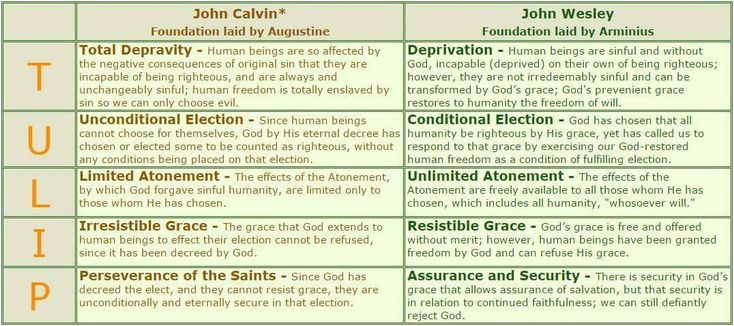
The reason this debate matters
Not everyone who would label themselves as a Calvinist agrees with all five points above. Those who would call themselves four-point Calvinists usually have trouble believing Limited Atonement. Likewise, many Arminians hold a view very similar to Calvinism’s view of Total Depravity. And many of them deny the last point of conditional security and holds to the view of eternal security.
The peace and joy that comes by faith alone in Christ alone
As a Calvinist, I want to be clear that I believe there are many true Christians in both theological camps. This debate is primarily a debate among Christians. However, it’s important that we dig deep within Scripture to receive the full peace and joy that it holds. In that spirit, I would like to offer the following thoughts:
- There is logical consistency between the five points within each side of the debate. So, if you pick and choose which points to affirm, your views become inconsistent.
- If you’re trusting in yourself at all for salvation, you’ve risked falling into the “faith plus works category” of belief. We have seen that this is a disastrous false gospel. Do not rob God of the full credit for your salvation. He doesn’t allow boasting when it comes to salvation. He wants and deserves all the glory and praise for it.
- Your peace in God and joy will skyrocket when you’re fully secure in God’s unfailing love. He will never disown a true believer in Christ.
- Your love for God will soar as you realize He did for you what you could not do for yourself.
- God knew you by name. He didn’t just hope to save an uncertain group of people. He chose you individually before the world began.
- God didn’t violate your free will. We’re in bondage to sin. We’re free to do what we want, but we don’t have the liberty to do what we ought.
Can you contribute anything to your salvation?
Can you answer the question, “Why did God save you, but not someone else”? That should truly be an unanswerable question. If you answered it was because of your faith, then why did you have saving faith when another person didn’t? Faith is a gift of God, so why did He grant it to you but not to another? If you think you can answer these questions, I think you’ve missed the meaning of grace. Grace is a completely undeserved gift from God. Man normally recoils at the idea that salvation fully depends on the sovereignty of God.
Yet, God holds man responsible for his moral choice to believe in His Son, whom He sent to save us. Would God hold us accountable for doing what we can’t do for ourselves as sinners? It may seem like a contradiction, but it’s really a paradox (an apparent contraction) that’s difficult for us to understand.
Many people believe their good works will help them earn their way to heaven. As we have seen, that belief damns countless millions of people. According to the State of Theology 2022 survey, 33% of US Adults don’t believe the truth that God counts a person righteous only because of faith in Jesus Christ, not because of one’s work. Just because someone lives in this country, we can’t assume that they know what Jesus Christ has done for them. It’s up to God’s people to share the truth with them.
Come to the wellspring of life
Ask yourself two very important questions. First, are you sure that you’ll go to heaven when you die? Secondly, are you certain why God should let you into heaven? If you don’t know for sure, you can settle that matter today. Visit my post, How to Begin Your Life Over Again and you’ll know where and how you’ll spend eternity.
And for crystal clear YouTube presentations of the gospel message from several trusted sources, click here.
References
- 1https://www.britannica.com/biography/Saint-Augustine. ↩︎
- 2article from https://www.theopedia.com/infused-righteousness ↩︎
- 3https://Selected portion of article from www.theopedia.com/imputed-righteousness ↩︎
- 4https://www.britannica.com/topic/Calvinism ↩︎
- 5https://www.britannica.com/topic/Arminianism ↩︎
- 6For more in-depth historical background, go to https://en.wikipedia.org/wiki/History_of_the_Calvinist%E2%80%93Arminian_debate#endnote_6-Picirilli ↩︎