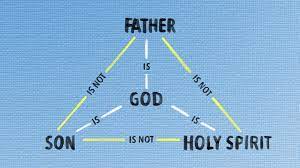
The Trinity is one of the most profound and distinctive doctrines of Christianity, encapsulating the belief in one God in three distinct persons: the Father, the Son (Jesus Christ), and the Holy Spirit. Each person is fully God, yet there is one God—an assertion that reflects the complexity and uniqueness of Christian theological reflection.
This article explores the scriptural foundations, historical development, and theological significance of the doctrine of the Trinity.
Scriptural Foundations
The doctrine of the Trinity, while not explicitly stated in the Bible, is inferred from a holistic reading of the scriptural text. The New Testament contains several passages that Christians have historically interpreted as indicative of the Trinitarian nature of God.
– Matthew 28:19
Known as the Great Commission, Jesus instructs his disciples to baptize “in the name of the Father and of the Son and of the Holy Spirit.” This passage is one of the clearest Trinitarian formulas in the Bible, linking the three persons together in a singular divine mission.
– John 1:1-14
The opening verses of the Gospel of John present the Word (Logos) as both with God and as God, and later identified as Jesus (v. 14). This passage has been foundational for understanding the divine nature of Christ and his eternal relationship with the Father.
– 2 Corinthians 13:1:
The apostle Paul concludes his letter with a Trinitarian blessing, invoking “the grace of the Lord Jesus Christ and the love of God and the fellowship of the Holy Spirit” upon the Corinthian believers.
– John 14-16
In these chapters, Jesus speaks extensively about the role of the Father, the Son, and the Holy Spirit, highlighting their distinct roles yet unified purpose in the salvation of humanity and the revelation of truth.
Historical Development
The development of the doctrine of the Trinity was a gradual process, influenced by theological debates and ecumenical councils in the early centuries of the Church.
– Apostolic Fathers and Apologists:
Early Christian writers hinted at a Trinitarian understanding of God, although their expressions were not systematically formulated. They spoke of the Father, Son, and Holy Spirit in ways that reflected a proto-Trinitarian theology.
– Council of Nicaea (AD 325):
The first ecumenical council was convened to address the Arian controversy, which denied the full divinity of the Son. The Nicene Creed affirmed the Son’s divine nature as “of the same substance” (homoousios) with the Father, laying a foundational stone for Trinitarian orthodoxy.
– Council of Constantinople (AD 381):
This council expanded the Nicene Creed to include a more detailed description of the Holy Spirit, affirming His divinity and proceeding from the Father, further solidifying the Trinitarian doctrine.
– Cappadocian Fathers:
Basil the Great, Gregory of Nyssa, and Gregory of Nazianzus, known as the Cappadocian Fathers, were instrumental in articulating the doctrine of the Trinity in the late 4th century. They clarified the distinction between “ousia” (essence) and “hypostases” (persons), helping to balance the unity and diversity within the Godhead.
Theological Significance
The doctrine of the Trinity is central to Christian faith because it shapes the Christian understanding of God, revelation, and salvation. It affirms that the God who creates, redeems, and sanctifies is one in essence yet distinct in personhood. This mystery invites believers into a relationship with a God who is both transcendent and imminently involved in the world.
Moreover, the Trinitarian framework underpins key Christian beliefs about the incarnation of Jesus Christ, the presence of the Holy Spirit, and the nature of the Church as a community called into the life of God.
Conclusion
The doctrine of the Trinity, which emerged through scriptural reflection and was refined in the crucible of theological controversy, remains a foundational tenet of Christian orthodoxy. It encapsulates the mystery of the Christian God: one in essence, three in personhood. This doctrine invites believers into a deeper contemplation of the nature of God, encouraging a faith that is rooted in both mystery and revelation.