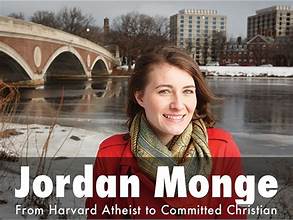
From Harvard Atheist to Christian: The Story of Jordan Monge (and why it matters for skeptics today)
If you had met Jordan Monge as a Harvard undergraduate, “future Christian” would not have been your first guess.
She was a sharp, committed atheist. She debated Christians in public forums, led atheist groups on campus, and saw religion as, at best, a crutch and, at worst, a dangerous delusion. Faith, in her mind, was what people turned to when they were afraid of the dark.
Then the ground under her worldview began to shift.
This is the story of how that happened—and why her journey speaks directly to many people wrestling with doubt, skepticism, and meaning today.
A Confident Atheist on Campus
Jordan didn’t stumble into atheism by accident; she owned it.
- She led an atheist student group at Harvard.
- She debated Christian students and pastors.
- She was convinced that belief in God had no rational foundation.
Christianity, as she saw it, was a relic of the past, unfit for modern, scientifically-minded people. If anything, she viewed herself as the rational voice in a world clinging to myths.
But even as she argued against God, she was serious about one thing: following the truth, wherever it led. That commitment would turn out to be crucial.
The Friendship That Opened a Door
Jordan’s story didn’t begin with a dramatic vision or a crisis that drove her to church. It began with something far more ordinary—and far more powerful:
A friendship.
She became close with a Christian student who was:
- Intellectually serious
- Honest about doubts
- Not threatened by hard questions
Instead of preaching at her, this friend listened, asked questions, and pointed her toward Christian thinkers who took reason and evidence seriously. He didn’t treat her as a project to be “won,” but as a person to be loved and understood.
Through that relationship, Jordan experienced something disarming: a Christian who was neither anti-intellectual nor afraid to be challenged.
That allowed her to do something she hadn’t really done before: give Christianity a fair hearing.
The Moral Challenge: Where Does Right and Wrong Come From?
One of the turning points for Jordan wasn’t a scientific argument or a Bible verse. It was a question that hit her at a deeper level:
On what basis can we say anything is truly right or wrong?
As an atheist, she believed in human rights, justice, and the equal value of all people. But as she pressed into the logic of her worldview, she began to see a problem:
- If the universe is only matter and energy,
- If humans are just highly evolved animals,
- If there is no objective standard beyond us—
then what grounds the idea that all humans have equal, intrinsic worth? Why is genocide wrong, not just distasteful? Why should we care for the weak when evolution seems to favor the strong?
She realized that she was “borrowing” moral concepts that made sense in a theistic framework but sat awkwardly on a strictly naturalistic one. She lived as if certain things were objectively good and evil—but her worldview didn’t really justify that.
This wasn’t an emotional crisis. It was an intellectual one. Her desire to be consistent forced her to look harder.
Encountering the Christian Story
As Jordan read more Christian philosophy and theology, a surprising possibility emerged:
Maybe the Christian worldview made better sense of the things she already believed and cared about.
In Christianity, she found:
- A basis for objective morality:
A good, personal God whose character is the standard of right and wrong. - A foundation for human dignity:
Every person made in the image of God, not just an accident of biology. - A framework for justice and mercy:
A God who hates evil, yet offers forgiveness, and calls His people to sacrificial love.
Bit by bit, she came to see that Christianity was not merely “emotionally comforting,” but intellectually weighty. It didn’t magically answer every question, but it did something her atheism couldn’t: it held together what she knew by reason, what she felt in conscience, and what she longed for in her heart.
Counting the Cost
Seeing that Christianity might be true and wanting it to be true are two different things.
Conversion had a cost for Jordan:
- It meant admitting she’d been wrong—publicly.
- It meant rethinking her identity, her friendships, and her future.
- It meant submitting not just her mind, but her life, to Jesus.
This was not a light, “spiritual-but-not-religious” shift. It was a reorientation.
Jordan wrestled through questions, doubts, and implications. But gradually, she reached a point where she felt backed into a corner—not by pressure from Christians, but by the weight of the evidence and the tug of conscience.
If her standard was to follow the truth wherever it led, she could no longer ignore where it was pointing.
In time, she walked into a church not as a critic or observer, but as a seeker ready to surrender.
She became a Christian.
Life After Conversion
Jordan’s story didn’t end with a single decision. It continued in the slow, imperfect, but real work of following Christ:
- Learning to pray and read Scripture.
- Rebuilding her view of herself, others, and the world.
- Integrating her sharp mind with a humble, living faith.
She didn’t stop being intellectually serious. She didn’t park her questions at the door. Instead, she brought them into a relationship with the One she had come to believe was both Truth and Love.
Her atheism had been rooted in a commitment to honesty and rationality. Christianity, she discovered, didn’t betray that commitment; it fulfilled it.
How Jordan’s Story Can Help People Today
Jordan’s journey is not a blueprint—everyone’s path is different—but it offers several powerful lessons for skeptics, Christians, and “in-betweeners” alike.
1. For Skeptics and Atheists: You Don’t Have to “Turn Your Brain Off”
Jordan’s story pushes back against a common fear: that becoming a Christian means abandoning reason.
Her path went in the opposite direction:
- Hard questions were not obstacles to faith; they were the pathway to it.
- She moved toward Christianity not because she ran out of arguments, but because the arguments for atheism proved too thin to bear the weight of reality.
If you’re skeptical today, her story suggests:
- You can take your doubts seriously without assuming that Christianity is off-limits to thinking people.
- You can ask, “Does my current worldview really explain what I know about morality, meaning, beauty, and human dignity?”
- You don’t have to fake certainty; you just have to be honest about where the evidence—and your conscience—are pointing.
You may not end up where Jordan did. But you owe it to yourself to examine Christianity at its strongest, not just at its weakest caricatures.
2. For Christians: Relationships Matter More Than “Winning Debates”
Jordan did not convert because a Christian “destroyed” her in a public debate.
She converted because:
- A Christian friend was patient and unafraid of her questions.
- She saw intellectual integrity and genuine love in believers around her.
- She was given the space to read, think, and wrestle without being coerced.
If you’re a Christian, her story is a reminder:
- Listen first. Many atheists are not driven by hatred of God, but by a love of truth and fairness—even if misdirected.
- Respect the mind. Don’t be afraid to recommend serious books, wrestle with philosophy, or admit when you don’t know an answer.
- Live a coherent life. A life of integrity, humility, and mercy can be harder to dismiss than a clever argument.
You don’t convert anyone. God does. But you can be the kind of friend who makes it easier, not harder, for others to encounter Him.
3. For “Cultural Christians” and Doubters: If You’re Going to Reject Christianity, Reject the Real Thing
Jordan opposed what she thought Christianity was—and then discovered that the real thing was deeper and more compelling than she’d ever imagined.
Many people today walk away from:
- A shallow childhood faith they were never allowed to question
- A version of Christianity that was all rules and no grace
- A caricature built from headlines, social media, or bad experiences
Her story invites a different approach:
- If you leave, know what you’re leaving. Engage with Christianity’s best thinkers, not just its worst representatives.
- If you stay, go deeper. Don’t be satisfied with slogans; seek a faith robust enough to face your hardest questions.
You may find, as she did, that Christianity is not smaller than your doubts—but larger.
4. For Everyone: Be Willing to Follow Truth, Even When It Costs You
Jordan’s deepest conviction before and after conversion was the same: truth matters.
Her story presses a hard but freeing question:
If you became convinced that Christianity is true, would you accept it—even if it cost you reputation, relationships, or comfort?
A lot of people say they’re “open-minded,” but only so long as the truth doesn’t demand too much change. Jordan’s life shows what happens when someone chooses integrity over convenience.
Whether you’re a believer or not, that kind of courage is worth imitating.
What You Can Do With Her Story
Jordan Monge’s journey isn’t just interesting; it’s useful.
- If you’re a skeptic:
- Find one or two serious Christian books and read them honestly (for example, C. S. Lewis’s Mere Christianity or Tim Keller’s The Reason for God).
- Seek out Christians who can talk without getting defensive. Ask your hardest questions.
- If you’re a Christian:
- Invest in long-term friendships with nonbelievers.
- Learn to articulate why you believe, not just what you believe.
- Model the combination Jordan saw: intellectual honesty and genuine love.
- If you’re unsure where you stand:
- Don’t rush. But don’t hide, either.
- Pray—honestly, even if you’re not sure anyone is listening:
“If You’re real, show me. Give me the courage to follow the truth.”
Jordan’s story doesn’t guarantee you’ll become a Christian. But it shows that:
- Faith and reason are not enemies.
- Atheism is not the only intellectually respectable option.
- Following the truth may lead you somewhere you never expected—and somewhere better than you dared to hope.
And that, in a world full of noise, cynicism, and shallow answers, is good news worth considering.
Recommended Reading
Based on the intellectual path she walked and the questions that drove her conversion, here are three books that almost certainly shaped her journey—and would benefit anyone in a similar place:
1. Mere Christianity by C. S. Lewis
Why this book matters for skeptics:
C. S. Lewis was himself a former atheist and Oxford intellectual who converted to Christianity. Mere Christianity was originally a series of BBC radio talks aimed at a skeptical, war-weary British audience.
What makes it powerful:
- Accessible but not shallow: Lewis writes with clarity and wit, never dumbing down the ideas.
- The moral argument: He walks through the famous “argument from morality”—the idea that our universal sense of right and wrong points to a Moral Lawgiver.
- Honest about objections: He doesn’t pretend Christianity is easy or that all questions have neat answers.
This is often the first book recommended to thoughtful skeptics because it treats the reader with respect and invites them to think, not just feel.
Best for: Anyone wrestling with whether morality, meaning, or the structure of reality make more sense with or without God.
2. The Reason for God: Belief in an Age of Skepticism by Tim Keller
Why this book matters for skeptics:
Tim Keller was a pastor in New York City who spent decades in dialogue with artists, academics, and skeptics. This book was written specifically for people who find Christianity implausible or even offensive.
What makes it powerful:
- Part I: Addresses the biggest objections to Christianity (suffering, exclusivity, injustice, science, etc.) with honesty and nuance.
- Part II: Makes a positive case for the truth, beauty, and coherence of the Christian story.
- Cultural sensitivity: Keller understands post-Christian culture and doesn’t talk down to doubters.
Unlike many apologetics books that feel defensive or preachy, The Reason for God feels like a respectful conversation with a thoughtful friend.
Best for: Anyone who says, “I want to believe, but I can’t get past [suffering / hypocrisy / exclusivity / science].”
3. The Abolition of Man by C. S. Lewis
Why this book matters for skeptics:
This short, powerful book explores what happens to humanity when we abandon objective truth and morality.
What makes it powerful:
- The danger of relativism: Lewis argues that if we reduce human values to subjective preferences or evolutionary impulses, we lose the foundation for human dignity, justice, and meaning.
- The Tao: He shows that all major civilizations have recognized a universal moral law—what he calls “the Tao.”
- Prophetic: Written in 1943, it predicted many of the ethical dilemmas we face today (bioethics, manipulation, dehumanization).
Best for: Anyone who cares deeply about justice, human rights, and meaning but wonders if these things can survive without God.
4. Orthodoxy by G. K. Chesterton
Why this book matters for skeptics:
Chesterton was a journalist and wit who moved from skepticism to Christian faith. Orthodoxy is his explanation of why Christianity, despite seeming strange or paradoxical, is the worldview that actually fits reality.
What makes it powerful:
- Joyful and surprising: Chesterton doesn’t argue in the usual way. He points out how Christianity explains paradoxes (humility and courage, mercy and justice) better than any alternative.
- The surprise of discovery: He describes stumbling upon Christianity as if he were an explorer who set out to find a new land—only to discover he’d sailed home.
- Witty and poetic: If Lewis is clear and logical, Chesterton is imaginative and delightful.
Best for: Anyone who finds Christianity weird but is open to the possibility that “weird” might mean “true in a deeper way than we expected.”
Start With One
If you’re drawn to Jordan’s story, you don’t have to read all three books at once.
Start with one:
- If you want clarity and logic: Lewis, Mere Christianity
- If you’re wrestling with specific objections: Keller, The Reason for God
- If you want to explore paradox and imagination: Chesterton, Orthodoxy
Then let the questions lead you forward.
Jordan’s journey didn’t happen overnight. It happened one conversation, one question, one chapter at a time.
Yours can too.
Other Resources Available:
- FaithAnswersPress.net: Grow in your faith and share your hope with others. Find biblical answers about the Christian faith. VISIT THE SITE NOW
- Download the FAQs of Faith app for easy access to Faith Answers Press LLC websites, answers to spiritual FAQs, and a daily faith-boosting podcast. DOWNLOAD NOW