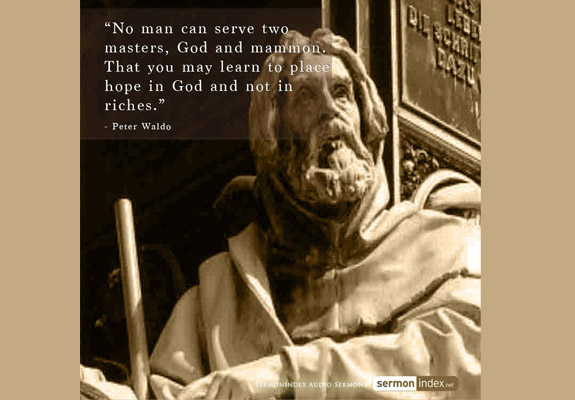
Peter Waldo was an early reformer who rejected church tradition. He was a wealthy French merchant, who underwent a religious conversion, and began to preach about voluntary poverty in the city of Lyon in southeast France. The more he studied Scripture, the more troubled he became over certain doctrines and practices of the Catholic Church. The church seemed greatly corrupted by its power. Waldo and his followers drew opposition from the Church because he boldly spoke out against these things.
Waldo is convicted of his sin and turns his life around
Most of what we know about Peter Waldo is based upon documents produced more than a hundred years after his death. However, there are a few remarkable things we do know. Peter had a wife, two daughters and plenty of property. He was a successful merchant in Lyon France, who apparently had amassed a great deal of wealth.
Peter Waldo came under conviction of his sin in the latter part of the twelfth century while listening to a troubadour. This particular troubadour was singing about the story of Saint Alexius, a fifth century mystic who abandoned his wealth to live by begging. The story impacted Waldo because he saw this as the surest path to heaven. He knew Christ had told the rich young ruler to “Go sell all you have, give to the poor, and come, take up your cross and follow me.”1https://christianhistoryinstitute.org/study/module/waldo-sought-a-truer-faith
As he grew in his faith, Waldo began to preach and teach in the streets. He also commissioned monks to create a translated copy of the Bible for him. (Waldo may be credited for providing Europe the first translation of the New Testament into the vernacular of the day.) He soon became fascinated with the concepts of purity and perfection. In his pursuit of purity, Waldo sold all he had, forswore his marriage and home, and put his two daughters into a convent.2https://en.wikipedia.org/wiki/Peter_Waldo
Waldo and his other lay followers spread the gospel
Waldo became increasingly disenchanted with the Catholic Church. It seemed greatly corrupted by its power and had forgotten Christ’s call to otherworldliness, poverty, and humility. There needed to be a return to Christian simplicity and less importance placed on the wealth and power of the church. The church managed to contain some unrest, especially through the monastic movements. But even these movements were becoming corrupted over time by wealth and immorality.3https://www.ligonier.org/learn/articles/peter-waldo-and-the-waldenesians
Waldo began traveling around begging and preaching about the value of poverty. He taught that “No man can serve two masters, God and Mammon.” As he gathered followers, they determined their own doctrines, which shared many of the features of the other reform movements, such as Cathars, the Humiliati, the Albingensians, and the Speronists. The doctrine of transubstantiation is an example of one such Catholic Church doctrine that Waldo rejected. Unlike the leaders of these other groups, however, Waldo had never joined the Catholic Church’s priesthood or any of its religious orders.4https://en.wikipedia.org/wiki/Peter_Waldo
By 1170, Waldo had gathered a large group of followers, who were referred to as the Poor of Lyons, the Poor of Lombardy, or the Poor of God. They evangelized as they traveled around as peddlers. They were characterized by their lay preaching, voluntary poverty, and their strict adherence to the Bible.5ibid
The Church eventually condemns Waldensian teaching
Soon, the followers of Waldo, also known as Waldensians, became a threat to the local clerics. The contrast between the ideals held by the Waldensians and the reality of the Catholic Church, led the archbishop of Lyons to order them to stop preaching. In response, Waldo quoted the Apostle Peter, “We must obey God rather than men.” So, the archbishops’ order didn’t stop Waldo or the movement, even though the archbishop excommunicated him.
The Waldensians appealed to Pope Alexander III at the time of the Third Lateran Council (1179). The Pope was impressed with these men, who traveled barefoot, two by two, wearing woolen clothes, and owning nothing. They held all things in common like the Apostles. So, the Pope allowed them to continue on the condition that they could not preach without a bishop’s approval.
Of course, no bishop was about to give that approval, and the Waldensians weren’t about to submit to the Pope’s condition. So, the Waldensians continued to preach, which eventually led to their excommunication by Pope Lucius III in 1184.
By 1207, Pope Innocent III offered to receive the Waldensians back if they would submit to the Catholic Church. Some returned but others didn’t, and in 1214 the Pope condemned them as heretics. The Inquisition then tried to stamp them out. However, the Waldensians continued and spread throughout Europe. And when the Reformation came, they were welcomed by most Protestants.6Curtis, Lang, and Petersen. The 100 Most Important Events in Christian History. Baker Book House, 2000, pages 77-78
Reflections on the life of Peter Waldo
Material wealth is often a barrier between us and God
Anything that is more important to us than God must be removed or devalued to be in a right relationship with Him.
For Peter Waldo, financial wealth stood in the way of his relationship with God. After listening to the troubadour sing about Saint Alexius giving all his wealth away to live a life of dependence and considering Jesus’ teaching about it, Waldo knew he could no longer hold on tightly to his material wealth. So, he chose to give it away.
Following the Word of God is better than following the religious traditions of man
Knowing that corruptible men can shape the doctrines and traditions of religious institutions places the primary responsibility for knowing God’s Word with each individual believer.
In Waldo’s day, lay people didn’t have access to the Bible in their own language. So, they relied on believing whatever the Catholic Church told them to believe. Waldo had such a hunger to read and interpret the Bible for himself that he hired capable monks to translate the New Testament in the vernacular of his day. Once he read God’s Word for himself, he could compare his interpretation with what the Catholic Church taught and reject what he believed to be wrong.
All believers in Christ have the duty to obey Him and encourage other believers to do the same
Jesus said, “If you love me, you will obey what I command.” And one of his commandments is to “go and make disciples of all nations, baptizing them in the name of the Father and of the Son and of the Holy Spirit, and teaching them to obey everything I have commanded.”
Peter Waldo took his responsibility for others to heart. Not only was he striving to live a simple and pure life himself, he traveled around the region to encourage others to follow his example. His message was so compelling that many others were convinced to do the same, and they became poor traveling messengers of God’s Word.
When divine and secular authority clash, we must obey God rather than men
When human authority forbids us to do what God commands or requires us to do what God forbids, God’s will must prevail. We must trust and follow God rather than men regardless of the consequences.
Peter Waldo appealed to the Pope when the archbishop of Lyons told him stop preaching. But when the Pope required him to obtain a bishop’s approval to teach, he didn’t feel bound to obey the Pope. He apparently knew that God would have him continue to preach regardless of any bishop’s decision. Waldo was also willing to face excommunication by the church rather than stop preaching. And he continued to bear much spiritual fruit for God.
The virtue of boldness
It is clear that Peter Waldo and his followers acted out their faith with boldness. In my opinion, this was a key reason why the Waldensian movement attracted so many followers.
John Piper describes the attribute of boldness like this.
The evidence of boldness is whether or not a person is making choices throughout the day that revolve around their desire to avoid conflict. If so, then that is a clear sign that cowardice is winning out over courage.
Likewise a person should ask if, in their personal walk with God, they avoid the Scripture passages that call for radical boldness. If that’s the case then the defeat is there before you even hit the streets.
Therefore we need to expose ourselves to the difficult parts of Scripture—the ones that call us to do tough things—as well as the more comforting parts.
John Piper, Desiring God7https://www.desiringgod.org/interviews/how-bold-should-christians-be
When we realize how much of an eternal impact we can have with others, how can we continue to avoid doing what we know God is calling us to do? May God richly bless you as you live boldly for Him!
Of course, if you have never placed your faith in Christ, that’s where your relationship with Him begins. Visit my blog, How to Begin Your Life Over Again, to learn more about your relationship with God. And to view some crystal clear YouTube presentation of the Gospel, click here.
References
- 1https://christianhistoryinstitute.org/study/module/waldo-sought-a-truer-faith ↩︎
- 2https://en.wikipedia.org/wiki/Peter_Waldo ↩︎
- 3https://www.ligonier.org/learn/articles/peter-waldo-and-the-waldenesians ↩︎
- 4https://en.wikipedia.org/wiki/Peter_Waldo ↩︎
- 5ibid ↩︎
- 6Curtis, Lang, and Petersen. The 100 Most Important Events in Christian History. Baker Book House, 2000, pages 77-78 ↩︎
- 7https://www.desiringgod.org/interviews/how-bold-should-christians-be ↩︎