A guilty priest brought Christianity to Scotland. Columba was an Irish abbot judged to be guilty over a quarrel that led to the breakout of war. In penance, he left his beloved Irish homeland to go to the island of Iona, where he established a monastery. From there, he sent out missionaries to bring the gospel message to the pagan Picts of Scotland.
The raising of a priest
Columba was born in Gartan (modern day County Donegal) in 521 into an Irish noble family. His name is the Latin for Colum-cille, which means “Dove of the Church.” When he was a boy, he was so often found praying in the town church that his friends called him this. The name Colm, or the Latin form, Columba, was the name he was know for the rest of his life.1https://st-columba.com/columba/
He was baptized by his teacher and foster-father Cruithnechan. He studied at the monastic school of Movilla at Newtownards, under Finnian. After his training, when he was about twenty years old and a deacon, he became a pupil of an aged bard named Gemman. Afterward, he entered the monastery of Clonard, which was noted for sanctity and learning. It was here that he absorbed the traditions of the Welsh Church. (Some of the most significant names in the history of Celtic Christianity studied at the Clonard Abbey.) He became a monk and was eventually ordained a priest in 551.
Mobhi Clarainech, who founded a monastery at Glasnevin, was another teacher of Columba. He is thought to have studied under St. Mobhi, but left Glasnevin following an outbreak of plague and journeyed north to open the House at Derry. In the following years, Columba established several other monastic foundations, including ones in Derry (545), Durrow (553), and Kells (554).2https://en.wikipedia.org/wiki/Columba
Columba was a striking figure of great stature with a powerful build. His loud, melodious voice could be heard from one hilltop to another. His strong personality and forceful preaching, however, could also arouse considerable antagonism.
A priestly quarrel that instigated a war between tribes
Around 560, Columba became involved in a quarrel with Finnian of Moville over a psalter (one that was allegedly copied by Jerome). Columba copied the manuscript at the scriptorium under Finnian, with the intention of keeping a copy for himself. But Finnian disputed his right to keep it. So, the dispute was about the ownership of the copy (whether it belonged to Columba because he copied it or whether it belonged to Finnian because he owned the original.)
The matter was taken on appeal to the Chief of the southern tribe of Ui Neill, the High King Diarmait mac Cerbaill. The king gave the judgement in favor of Finnian, saying, “To every cow belongs her calf, therefore to every book belongs its copy.” Columba disagreed with the ruling against him. So, in 561, Columba reportedly instigated a successful rebellion of Columba’s northern Ui Neill tribe against the king’s southern tribe. This battle of Cul Dreimhne (also know and the Battle of the Books) is claimed to have caused 3,000 casualties.
The judgment and guilt that sent Columba to Scotland
A synod of clerics threatened to excommunicate Columba for these deaths. But Brendan of Birr spoke on his behalf. He prompted the assembled clerics to sentence Columba with exile rather than excommunication. Brendan, who was Columba’s soul-friend and confessor, assigned a penance for his actions of going into exile and the saving of 3,000 souls for the gospel. This was the same number as the number of men who were slain on the battlefield.
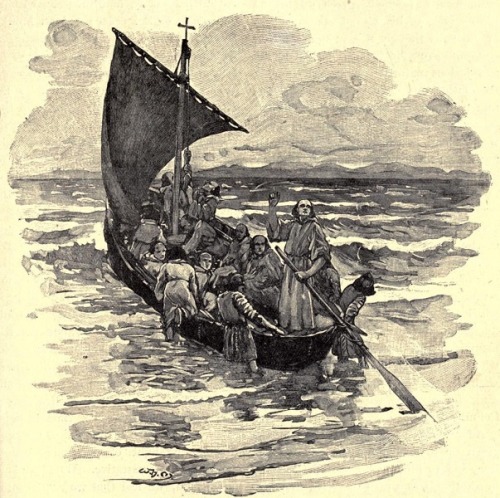
Due to contradictory accounts, we’re not sure whether Columba was sent away as punishment or left because he considered himself partly responsible for the deaths. But in either case, Columba and twelve of his companions sailed from Ireland in 563, at the age of forty-two, and landed on the island of Iona, off the coast of Scotland. This island had supposedly been given over to him by his kinsman Conall mac Comgaill King of Dal Riata, who may have invited him to Scotland in the first place. It was from Iona that Columba began a missionary effort to bring the gospel to the pagan land of Scotland.
There’s a sense that Columba was not leaving his native country, as the Ulster Gaels had been colonizing the west coast of Scotland for the previous couple of centuries.
Spreading the gospel to the pagans in Scotland
While Ninian (c. 350 – 432) a Briton, was undoubtedly the most significant of the early Scottish saints, Columba clearly became the greatest Scottish saint of all. He quickly established the island of Iona as a center of religious learning. But Columba didn’t stay on the island; He was a tireless missionary. He had the stature to deal directly with kings to obtain safe passage on what could otherwise be very dangerous journeys converting their people to Christianity.
Be thou a bright flame before me,
Saint Columba
Be thou a guiding star above me,
Be thou a smooth path below me,
Be thou a kindly shepherd behind me,
Today, tonight and forever
Columba gradually began to convert the Picts and then the Angles to Christianity. He was able to pull the separate races of what would one day become Scotland together. The monasticism practiced by Ninian and Columba in sixth century in Celtic territory emphasized missionary outreach and community life. Celtic Catholicism did not regard itself as identical with Roman Catholicism.
We think of monks as world-withdrawing rather than gospel-spreading. But these early monks in the Celtic tradition should be seen in a different light. Think of the best of them as men who devoted themselves to spreading the gospel.
Sinclair Ferguson – In the Year of Our Lord: Reflections on Twenty Centuries of Church History
Columba’s continued influence in Ireland
Although Columba left Ireland, he returned several times in relationships with the communities he had founded there. On one such occasion, he revisited Ireland to attend a national convention of the Irish tribes. His dominant influence enabled him to settle a dispute between the Irish bards and the high king concerning the essential position of the bards in society. After Columba convincingly defended the singing poets, 1,200 bards entered the meeting and lauded him in song.3Robert D. Linder, edited by John D. Woodbridge. Great Leaders of the Christian Church. Moody Press. 1988. pages 99-102
Until the very end of his life, Columba exercised his enormous prestige and gifts to secure success of his incredibly important mission. He died on Iona in 597 at the age of 75 while attending a traditional midnight service with his brethren.4ibid The missions from Iona continued long after his death.
Reflections on the life of Columba
God may sideline Christians temporarily to prune them for greater service in the future
Circumstances change and disappointments happen, but God still uses imperfect people to accomplish His purpose.
It must have been quite a disappointment for Columba when he acknowledged his responsibility for the death of so many men at the Battle of the Books. Nevertheless, he wasn’t about to let his shame over this event sideline him for long. As soon as he landed in Iona, he began building a monastic community as a hub, from which he could travel to Scotland to promote his version of Celtic Catholicism. Columba would not let his responsibility and zeal for being “all in” for Christ to be diminished.
Our past experiences are valuable building blocks to equip us for future challenges
Our past is instructive for our future. Past successes help us understand how to best channel our future energies, and past failures keep us humble and remind us of our dependence upon God.
Columba was educated and trained in multiple monasteries and he had been under the tutelage of experienced mentors. This preparation, along with his experience living in monastic communities, must have been invaluable as he established monasteries first in Ireland and later at Iona and throughout Scotland.
Christian service begins with a love for learning and growing in God’s Word
Jesus said, “everyone on the side of truth listens to me” (John 18:37). Everything necessary, everything binding on our consciences, and everything God requires of us is given to us in Scripture (2 Peter 1:3).
Columba was well grounded in the traditions of Celtic Christianity, but he had a special love for God’s Word. He went to great lengths to copy the psalter and defend his right to keep it so that the monastery he established would order their life around God’s Word.
Reaching out to others with the gospel is the life blood of ministry
The Celtic monastic life was built on the dual principle that building the church lies at the heart of Christ’s vision and the church as a community is His chief evangelistic agent.
The founding of a monastic community was a form of church planting. It was just the same as a missionary compound with its doors open to the surrounding community. Columba and his fellow monks traveled extensively throughout Scotland to spread Christianity by planting these monastic communities.
The power of the gospel is best expressed in community life
The impact of a church within a community depends on the relevance of its members to the community.
Rather than planting monastic communities that lived in isolation from the community, Columba established monasteries that were well integrated into their communities. Members could best influence the community by living exemplary lives, visible for others to see and desire for themselves.
God calls people to reject the values of society to fully serve Jesus Christ
Jesus Christ is calling his followers to be radically devoted to Him, willing to go anywhere and do anything He calls them to do.
Columba and the other missionary monks were willing to go anywhere and do anything simply because Christ had called them. Their union with Christ meant much more to them than their ties to worldly concerns.
God may use major setbacks to prune His people for greater service
The greatest lessons we learn about ourselves, our life direction, and God Himself more easily come in times of difficulty. When we “hit a brick wall” and are forced to change directions in life, we’re more likely to strive to understand God’s purpose for us and act accordingly.
For Columba, the time came when he was judged to be at fault for instigating a rebellion. He could not continue as usual. So, God sent him to a lonely island from where He would plant Christianity in a country full of pagans. Had this “set back” never happened, history would never have recorded such an improbable accomplishment as Columba experienced.
We all experience setbacks in life. It could be from the loss of a job, the death of a family member, financial ruin, divorce, etc. However, God can turn your disappointment into greater fruitfulness for Him and a greater resulting joy for you. If the problems of life have overcome you, visit by blog, How to Begin Life Over Again. You will learn more about God and reasons for believing in Christ. And to learn more about being saved from your sin, click here.