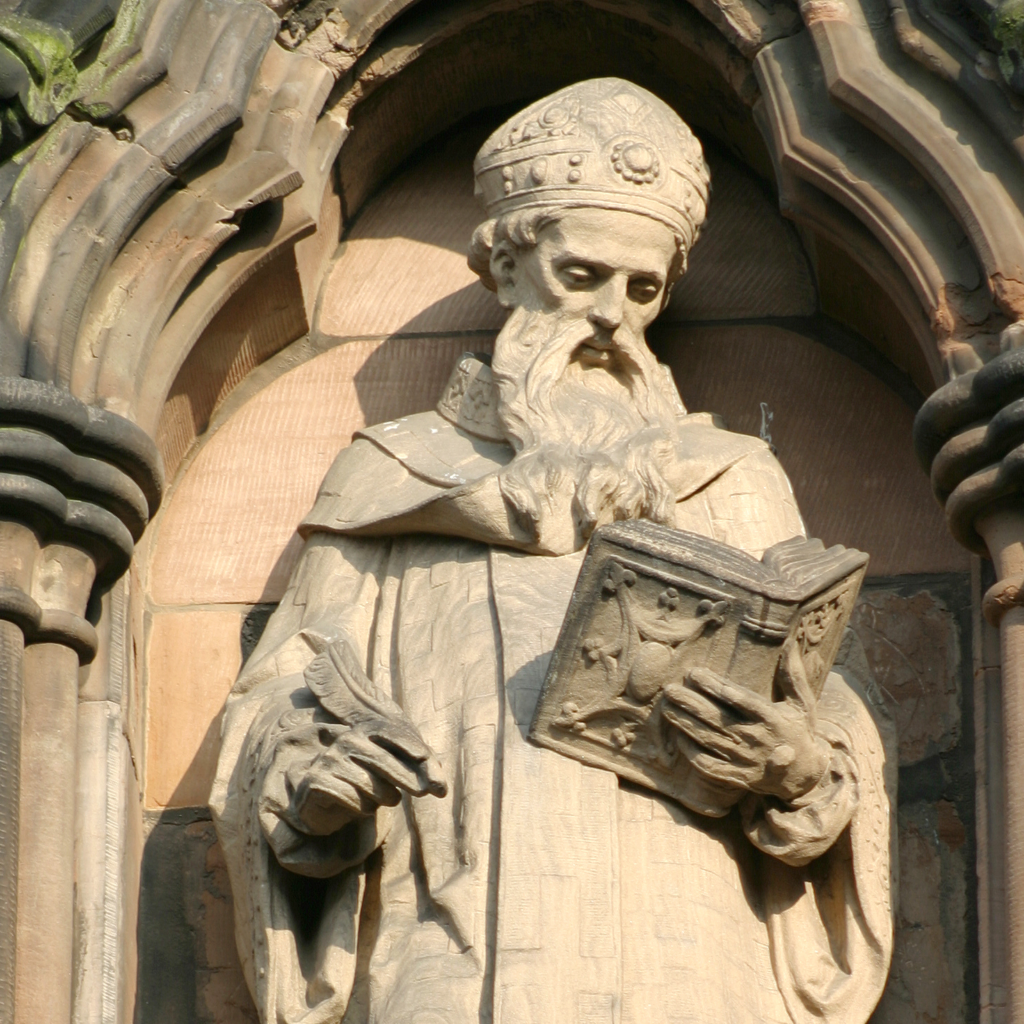
Athanasius was a man who stood firm for the truth. He was exiled five times by four Roman emperors. He spent 17 years of his 45 years that he served as Bishop of Alexandria in exile, because he insisted that Arianism was in fact a heresy. Yet in the end, his theological enemies were defeated and Athanasius’ writings shaped the future of the church.
The background of Athanasius
Athanasius was a noted Egyptian Christian leader of the fourth century. He was born to a Christian family in the city of Alexandria, a culturally vital city of the Roman Empire, between 293 and 298. His parents were wealthy enough to give him a good secular education.
Athanasius learned his theology and pastoral skills under Alexander, the bishop of Alexandria, first as a deacon and later as his secretary. He served in a support role at the Council of Nicaea in 325. Nearly all of Athanasius’ works came after Nicaea and were used to defend the orthodoxy of the Nicene Creed.
The threat of heresy to the formation of the early church
In the second century, opposition to Christian faith came in two different forms: physical persecution and false teaching. One of these enemies is much more dangerous than the other. The early church new that martyrdom could never ultimately kill the believer or the church. But false teaching always does.
There is always the danger of syncretism whenever the gospel enters into a culture. The message is often adapted to the receiving culture in a way that dilutes the message being conveyed. Consequently, people who respond to the message can meld the gospel to their own previous convictions, which produces a mixture of gospel and paganism.
The heresy of Gnosticism
In the early church, Gnosticism emerged, which disguised itself as a superior form of Christianity, but in reality it denied its core beliefs. It taught that the spirit world was good, but the material world was evil. As the name of its world and life view implies, it places a special importance on gaining special knowledge, which is given only to its initiates. The dual nature of good and evil would also mean that God could never become incarnate, thus denying the humanity of Jesus Christ. However, if Jesus had no human nature, he could not represent and save those who are truly fallen humans.
The heresy of Modalism
The early church also struggled with how to understand the relationship between God the Father, the Lord Jesus Christ, and the Holy Spirit. It’s clear from the Bible there is only one God, so how can Jesus be God if the Father is God, and likewise for the Spirit? That notion would seem to support the idea of tritheism (the belief that the Father, Son, and Holy Spirit are three separate and distinct gods.)
In an attempt to preserve both the concept of one God and the deity of Christ, another idea called modalism emerged. It holds that God reveals himself under different aspects or modes in different ages. He is called the Father as he relates to creation and the giving of the law; He’s known as the Son in Jesus Christ and as the Spirit after the ascension.
Modalism stresses the full deity of Christ and avoids the suggestion that he is a different God from the Father. But unfortunately it abandons the concept that Christ is our representative or advocate with the Father. The conclusion of this idea is that while Christ was fully God, he only appeared to be man.1Harold O.J. Brown, Heresies: Heresy And Orthodoxy In The History Of The Church, Baker Books (edition reprinted by Hendrickson Publishers, 1998, page 99
The heresy of Arianism
The question of whether Jesus was God or not continued to remain unanswered. So, another speculative view arose. This one was originated by Arius, a priest and false teacher in the early fourth century. Arius was an anti-Modalist who denied the deity of Jesus Christ. He taught that Jesus was created by God as the first and greatest act of creation and that he was unlike God the Father. Thus, Arianism is the view that Jesus was created with some divine attributes, but he’s not eternal and not divine. He is more like us than he is like God. Arius believed that the Son’s status is a consequence of the will of the Father to honor him in rank above other creatures, not to imply that they share the same being or status.
Athanasius held that this view of the Son being a creature had two decisively negative consequences. First, no creature can save another creature. Only God can save. Only He can break the power of sin and bring us to eternal life. Secondly, if the Son is a creature, then Christians are guilty of worshipping a creature instead of God. They have lapsed into idolatry.2Alister M. McGrath, Historical Theology, Blackwell Publishers, 1998-2000, pp 49-50
The teaching by Arius gave rise to great controversy, starting in Alexandria, then spreading out to other regions in the Roman Empire. Arianism was perceived as one of the most dangerous and pernicious of errors. For a time, however, it was so successful that its adherents were elevated to the most important bishoprics and it controlled the major part of the Eastern church. Therefore, the need for a council to decide the problem became necessary.
The Council of Nicaea in 325 defined Trinitarian orthodoxy
Not wishing to divide the empire over this religious controversy, Constantine called for a church-wide council to meet and decide the doctrine for the church. The emperor led the bishops debate. Athanasius, who was ordained a deacon in 319, served as Bishop Alexander’s secretary.
Arius plainly proclaimed that the Son of God was a created being, and unlike the Father, He was capable of change. Constantine prodded the 300 bishops at the council to make a decision by majority vote defining who Jesus Christ is. They chose to use the word “Homoousios”, meaning “of the the same substance”, to describe Christ as having the same essence as the Father. With only two dissenting bishops (who wanted to use the word “Homoiousios”, meaning of like or similar substance), they voted to make the full deity of Christ the accepted position of the church.
The statement they adopted, known as the Nicene Creed, would be the doctrine all of Christianity would follow and obey. The council did not invent the doctrine of the deity of Christ. Rather, the Council of Nicaea affirmed the apostles teaching of who Christ is–the one true God and the Second Person of the Trinity, with the Father and the Holy Spirit.
Arianism continued beyond the church’s decision to abolish it
Though Emperor Constantine seemed pleased with the results of the Council’s work, it did not last. Arius’ theology remained for decades even though he and the other two dissenting bishops had been exiled. Athanasius became one of Arianism’s most capable foes, first as a deacon of Alexandria and in 328 as the bishop of Alexandria. The battle was hotly waged throughout the Eastern church until another council held in Constantinople reaffirmed the Council of Nicaea.3A. Kenneth Curtis, J. Stephen Lang, Randy Petersen. The 100 Most Important Events if Christian History. Fleming H. Revell (Baker Book House Co.). 2000 (7th printing). pp. 34-36.
Athanasius suffered for defending the divine nature of Christ
When Bishop Alexander of Alexandria was on his death-bed, he called Athanasius, who fled fearing he would be forced to become the next bishop. He was very unwilling to accept this honor, for he could clearly foresee the troubles that lie ahead. But the clergy and the people were determined to have him as their bishop and refused to accept his excuses. He finally consented to accept the responsibility that he sought in vain to avoid. So, he was consecrated in 326, when he was about thirty years old.
Athanasius could see the problems that come from describing the Son as a creature–namely, that he cannot be our Lord and Savior. So after the council finished its work, and Arianism continued to rise in the East, he devoted the rest of his life teaching and defending the orthodox doctrine on the Trinity.
For his staunch defense of the Nicene Creed, he was the target of opponents of the Nicene Creed. Supporters of Arius talked Constantine into ending Arius’ exile and ordering Athanasius to restore him to fellowship. When he refused, his enemies spread false charges against him, which led Constantine to exile Athanasius to Trier (a German city near Luxembourg). After Constantine’s death, Athanasius returned to Alexandria. But he was banished again by Arian church leaders who had gained the upper hand when he was away. He returned in 346 and was banished three more times before he came back home in 366, at about the age of 70.
During the forty-eight years of his episcopate, he spent over seventeen years in five exiles by four different Roman Emperors. Moreover, there were about six incidents in which he fled to escape people who were seeking to take his life.
Athanasius was instrumental in finalizing the New Testament Canon
During the first year that Athanasius was back to permanently stay in Alexandria, he sent a festal letter to all the churches in his diocese. These letters were used to set the dates of festivals, including Lent and Easter, and to discuss other matters of general interest. In his 367 A.D. letter, Athanasius listed what he considered were the writings that should constitute the New Testament.
“These are fountains of salvation, that they who thirst may be satisfied with the living words they contain. In these alone is proclaimed the doctrine of godliness. Let no man add to these, neither let him take ought from these. For concerning these the Lord put to shame the Sadducees, and said, ‘Ye do err, not knowing the Scriptures.’ And He reproved the Jews, saying, ‘Search the Scriptures, for these are they that testify of Me.’”
Athanasius, Easter letter of 367 A.D. (Item 6)
Athanasius’ list of writings are the ones that the church would eventually adopt. And they are still the ones that we use today.4https://www.christianitytoday.com/history/people/theologians/athanasius.html
Reflections on the life of Athanasius
Affirming the truth about God matters
Rejecting the truth about Jesus’ full humanity and His full divinity leads to a belief in a false gospel.
Athanasius knew the danger of teaching that Jesus was a created being, even one who was the greatest one of all creation. If He wasn’t God, He would have no power to save sinners, and He could not survive the infinite punishment our sins deserve. But if He wasn’t man, how could He qualify to represent man before a God, whose justice and wrath toward sinners demands the penalty of death?
For Jesus to qualify as the mediator between God and man, He had to be both truly man and truly God, thus having two natures in the single Person of Christ. Trusting in only a man to save us, or a divine being to represent us before God would fall short. Only the incarnate Son of God can save us.
Fidelity to the truth about God’s triune nature may often bring extreme opposition
One of the ways unbelievers try to distort the truth is to oppose those who are willing to defend it, despite the personal cost of doing so.
Arius and his followers were never satisfied with the agreed upon statement that Jesus is God, having the same substance as the Father. So, they never gave up their fight against Athanasius who was so tenacious in defending the orthodox doctrine decided at Nicaea. They took advantage of the emperors’ overriding desire to keep the empire unified by creating division and strife wherever possible. Time after time, this opposition resulted in the emperor’s willingness to compromise with the Arians by ordering Athanasius to modify his position on the matter.
Despite the attacks, however, Athanasius was willing to stand firm for the orthodox faith even when faced with exile, or even worse. By doing so, he underscored the importance of the trinitarian doctrine approved at the Nicene Council.
Following God’s will reluctantly is better than breaking a prior commitment to follow it
In Matthew 21:28-32, Jesus tells the parable of two sons. The first son refused his father’s command to work in the vineyard, but later he changed his mind and went. However, the second son agreed to go, but he did not go. So, Jesus asked, which of the sons did what the Father asked. The answer, of course, was the first. As followers of Christ, we may initially resist following God’s will. But we consent to doing it because He is our Lord and our love for Him demands it.
When faced with the expectation of being named Bishop of Alexandria, Athanasius fled to avoid the foreseeable trouble ahead. But when pressed by the clergy and people to take it, he apparently knew it had to be God’s will. So, he was willing to accept the responsibility, not for his own sake but for the sake of Christ’s church.
God can produce a great contribution to His kingdom from a faithful servant
Godly people who live a proven life of great integrity may be used to achieve amazing results for His Kingdom.
Athanasius was well known throughout the Christianized world. Through many synods and councils, he was a key spokesperson for preserving the Nicene Creed as orthodoxy for the church. His reputation for standing firm for the faith through the persecution he endured, was beyond question. Therefore, he was able to exercise great influence in finalizing the New Testament Canon when he wrote his Easter Letter.
The importance of doctrinal truth in the life of a believer
Believing in Jesus Christ alone is the only way for salvation. But many people who profess to believe do not believe in the same Jesus who is revealed in sacred Scripture. A recent survey of theological beliefs among all Americans reveal some surprising results. For example, 53% of all Americans agree or strongly agree that Jesus was a great teacher, but He wasn’t God. And 55% of Americans believe Jesus is the first and greatest being created by God. Both results show that a majority of Americans disagree with the biblically-revealed portrait of Christ as the incarnate God.
Knowledge of some doctrines of the Bible may not be necessary for salvation. However, outright rejection of what the Bible says about the nature of Christ raises genuine concern over one’s spiritual condition. Jesus proved He was a man by dying and He proved He was God through His resurrection from the dead. He not only claimed to be God’s Son, He proved it by performing miracles that only God can do.
To learn more about God and reasons to believe in Jesus, click on the Blog Search page. Then download the free digital PDF files. For a topical listing of posts, go to the Post Directory page.
References
- 1Harold O.J. Brown, Heresies: Heresy And Orthodoxy In The History Of The Church, Baker Books (edition reprinted by Hendrickson Publishers, 1998, page 99 ↩︎
- 2Alister M. McGrath, Historical Theology, Blackwell Publishers, 1998-2000, pp 49-50 ↩︎
- 3A. Kenneth Curtis, J. Stephen Lang, Randy Petersen. The 100 Most Important Events if Christian History. Fleming H. Revell (Baker Book House Co.). 2000 (7th printing). pp. 34-36. ↩︎
- 4https://www.christianitytoday.com/history/people/theologians/athanasius.html ↩︎