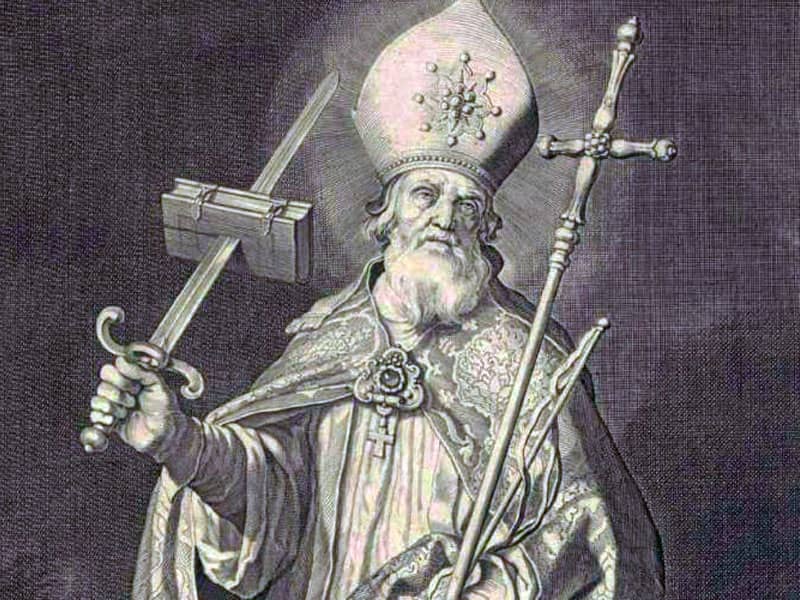
Boniface was a man who brought the Christian faith to Germany. As he evangelized pagans, he also brought needed reforms to the church. He was born as Winfrith at Crediton, in the little Saxon kingdom of Wessex. He traveled from England to Frisia and Germany in the seventh century to evangelize the mostly pagan tribes there, and organize the scattered community of Christians.
Boniface’s early life
Winfrid, later to be given the name Boniface, was born into a Christian family of noble rank sometime between 672 and 675. When he was a small boy, Winfrid listened to the conversation of some monks who were visiting his home. He then decided to enter the Church. Although his father had other secular plans for Winfrid, a serious illness altered his attitude, and the boy was sent to the nearby abbey of Exeter. Later, Winfrid studied at the abbey of Bursling. Upon completion, Winfrid was appointed as head of the school.
Winfrid’s teaching attracted many students, and he wrote a grammar for them that was copied and circulated among other monasteries. And at the age of thirty, he was ordained as a priest.
The early failure of Boniface’s first missionary effort
While Winfrid’s advancement in the English Church was assured, God revealed to him that his work was to be in foreign lands, as the need was greater there. Much of Northern and Central Europe were worshiping pagan deities. The Northumbrian missionary Willibrord had been striving to bring the Gospel to the Frisians, in what is now the Netherlands.
Winfrid felt called to go Friesland. So, he got the consent of his Abbot, and in the spring of 716, he traveled to Doerstadt in Friesland, along with two of his companions. This trip would turn out to be a failure for Winfrid, because Duke Radbod of Friesland, who was an enemy of Christianity, was at war with Charles Martel, the Frankish duke. The pagan Frisian king Radbod had wiped out Willibrord’s work in Frisia. Therefore, Willibrord was obliged to retire to his monastery at Echternacht
Knowing that this was not the time to evangelize the region, Winfrid returned home to England in the autumn. Although his monks at Bursling wanted Winfrid to stay and elect him abbot, he wasn’t about to be deviate from his missionary purpose.
Boniface meets with Pope Gregory II in Rome
After Winfrid’s first missionary effort, he understood that he must have a direct commission from the Pope to be effective. So, in 718, he presented himself to Pope Gregory II in Rome, with commendatory letters from the bishop of Winchester. The Pope warmly greeted Winfrid. He told Winfrid, “You seem to glow with the salvation-bringing fire which our Lord came to send upon the earth.”
It was during this time that the Pope changed Winfrid’s name to Boniface. The name means “good works”, and he was named after a Roman Christian who was martyred in the Arian controversy.
Boniface assured the Pope that he would use the Roman, not Celtic, formula for baptism. So, the Pope commissioned Boniface to evangelize both those “led astray …and now serve idols under the guise of the Christian religion” and those “not yet cleansed by the waters of holy Baptism.” Then, once traveling conditions were favorable, he sent Boniface out to preach the word of God to the heathen.
Boniface journeys back to the mission field
“Let us preach the whole of God’s plan to the powerful and to the humble, to rich and to poor, to men of every rank and age, as far as God gives us strength, in season and out of season.“
Saint Boniface
Missionary to Friesland. Boniface left Rome, crossed the lower alps, and traveled through Bavaria to arrive in Hesse, a state in the west-central part of Germany. He then labored under Willibrord for three years in Friesland, because Duke Radbod had died and his successor was more friendly. But Boniface declined to become the successor of Willibrord in Friesland, who was now very old. He claimed that his commission was to the heathen and therefore he could not be limited to just one diocese. So, he returned to work in Hesse.
Missionary to Hesse. Language barriers were not significant for Boniface since the dialects of the native tribes closely resembled his native Anglo-Saxon. His success in reaching the people for Christ was partly due to the interest he won among two powerful local chieftains, Dettic and Deorulf. These men had been previously baptized, but due to a lack of instruction, they were living just a little better than pagans. However, with the help of Boniface, they became zealous for the Christian faith and influenced many others to be baptized. They also gave Boniface some land on which he later established the monastery of Amoeneburg.
Greater authority given Boniface by the Pope
Due to his success in Hesse, Pope Gregory II summoned him back to Rome to be ordained as Bishop. In 722, the Pope consecrated Boniface as regionary bishop. His authority would extend to “the races in the parts of Germany and east of the Rhine who live in error, in the shadow of death.”
The Pope also helped Boniface secure civil protection, by giving him a letter to take to the powerful Charles Martel, who granted him what he asked. Now armed with authority from both the Church and the civil power, Boniface was in a strong position to evangelize the pagans.
Boniface boldly chops down a huge sacred oak tree
Boniface decided to root out pagan superstitions that was affecting the stability of his converts. So, on a day publicly announced and in the midst of an awe-struck crowd, he and one or two of his followers took their axes and attacked a sacred oak tree. After just a few blows, the tree came crashing down. The pagan crowd worshiped Thor, the god of thunder, and this ancient tree was believed to be most sacred to him.
The terrified tribesmen expected Thor to instantly punish the perpetrators of this act. But now they witnessed that their god was powerless to protect even his own sanctuary. In and act of victory, Boniface took the wood from the fallen tree to help build a chapel on that very spot. From that time on, the work of evangelization in Hesse progressed steadily.
Boniface restores order and established monastaries
Boniface moved east into Thuringia to further his evangelistic efforts. While there, he found some undisciplined Celtic and Irish priests, many who held heretical belief and others who lived immorally. These priests became hindrances to Boniface. So, he restored order among them.
He also established a second monastery at Ohrdruff, which is near Gotha. The people everywhere were ready to listen, but there was a lack of teachers. So, Boniface appealed to the English monasteries and convents. This produced large numbers of monks, nuns, and schoolmasters, who willingly came over and placed themselves under Boniface’s direction.
With the infusion of this help, Boniface not only expanded the two monasteries, he also founded some new ones. And in 731, the Pope sent him the pallium, appointing him archbishop of all Germany beyond the Rhine and giving him the authority to establish new bishoprics.
And a few years later, Boniface made his third trip to Rome, where he was appointed apostolic legate. He gathered more missionaries at Monte Cassino (Italy) and traveled to Bavaria in his capacity as legate. In Bavaria, Boniface organized the church into four bishoprics. He then returned to own field and established bishoprics in Thuringia, Hesse, Franconia, and Nordgau. An English monk was placed at the head of each new diocese. And in 741, the Benedictine Abbey at Fulda was founded. Its first abbot was Sturm, Boniface’s young Bavarian disciple.
Boniface’s influence reforms the church in Gaul and Britain
Reform in Gaul
While evangelization of Germany was going well, the Church in Gaul was disintegrating under the Merovingian kings. The high church offices were either vacant, sold to the highest bidder, or given to the unworthy. It wasn’t unusual that a single person would occupy multiple full-time offices at the same time, a practice known as pluralism. The great majority of the clergy was ignorant and undisciplined. And no synod or church council had been held for eighty-four years.
Furthermore, Charles Martel, who regarded himself as an ally of the papacy, plundered the church to help support his wars. And he did nothing to help reform the church. However, at his death in 741, his sons Carloman and Pepin the Short created just the right opportunity for Boniface to bring long-needed reforms. The elder son, Carloman, was very devout and greatly respected Boniface. At the urging of Boniface, he called a synod to deal with the errors and abuses in the Church in Austrasia, Alemannia, and Thuringia.
The first assembly was followed by several others, and Boniface presided over all of them. He was able to carry out many important reforms of the church. After five years of work, Boniface managed to restore the church in Gaul to its former greatness.
Reform spread to Britain
Now, Boniface wanted Britain to share in this reform movement. At the request of Boniface and Pope Zacharias, the archbishop of Canterbury held a church council at Clovesho in 747. At the council, many of the reforms that were passed in Gaul were also adopted in Britain.
Boniface crowned Pepin King of the Franks
After Carloman retired to a monastery, his brother Pepin brought all of Gaul under his control and gave Boniface his support. In a letter to England, Boniface gave tribute to the civil authorities who had supported him. He wrote, “Without the patronage of the Frankish chiefs, I cannot govern the people or exercise discipline over the clergy and monks, or check the practice of paganism.”
As apostolic legate, Boniface crowned Pepin as King of the Franks in 751. This act was an important acknowledgment by the father of Charlemagne that the Pope had the divine right to crown future kings.
Boniface returns to the mission field and is martyred
When Boniface was past seventy, he still had the missionary zeal to spend his remaining years laboring among the first converts in Friesland. They had been relapsing once more into paganism since Willibrord’s death. So, he and about fifty companion sailed down the Rhine to Utrecht, where he was joined by Eoban, the bishop of that diocese. Together they began working to reclaim relapsed Christians. They also made effective contacts with unreached tribes to the northeast.
Boniface arranged to hold a confirmation service on the plain of Dokkum, near the little river Borne. While waiting for the arrival of his converts, suddenly a band of armed pagans appeared.
“Let us trust in Him who has placed this burden upon us. What we cannot bear, let us bear with the help of Christ. For He is all-powerful, and He tells us: ‘My yoke is easy, and my burden light.'”
Saint Boniface
As he was telling his companions to trust in God and welcome the prospect of dying for him, the pagans attacked. Boniface would not allow his companions to defend him. He lifted the book he was reading above his head to save it when the blow fell. He was one of the first to fall. And his companions also shared his fate.
The pagans, who were expecting to carry away some riches, were disgusted when they only found provisions, some books and a box of holy relics. These were collected later by the Christians who came to avenge the martyrs and rescue their remains. The body of Boniface was taken to Fulda for burial, where it remains to this day, along with the book that he was reading.
Reflections on the life of Boniface
Exposure to Christian service at an early age can create the passion that lasts a lifetime
A child’s passion can be sparked by observing some admirable activity or interaction that capture’s their imagination.
When Winfrid was a young child, he overheard the conversation of missionaries who were at his home. From that time on, Winfrid was inspired to join the church. The Lord arranged Winfrid’s Christian education in spite of his father’s other plans. And his early studies revealed his teaching and leadership skills. Winfrid’s passion for using his spiritual gifts in service to the Lord never died.
Failure in ministry can be the means God uses to change our direction or methods
Events outside of our control may limit our success and alter our course. But God may use those disappointments to place us in a better position to achieve the results he desires.
Winfrid’s failure in his first missionary journey to Friesland was certainly a setback that sent him back home to Britain for a short time. But Winfrid took that time and realized that he would need the backing of the Pope to be effective. So, he headed to Rome to see the Pope. This initial failure would not stop Winfrid from doing what God called him to do; It served as a course correction.
Influence and effectiveness may be enhanced by association with recognized authorities
Our association with known people and organizations, who are highly regarded by others, often gives us the credibility needed to influence others.
Boniface’s formal ties with the papacy gave him the institutional authority he needed to bring reform to the church. And he said that without the patronage of the Frankish chiefs, he could not have exercised the discipline required to bring reform to the church. Both church and secular backing and protection were necessary for Boniface’s remarkable ministry.
Acting courageously for advancing God’s kingdom may be needed to break strongholds
Our trust in the Lord helps us overcome our natural fear with bold and courageous action. And it’s this kind of action that can impact others to change their perspective.
For Boniface to persuade the pagans to turn away from their false god Thor and turn to Christ, he needed to do something very bold. He needed to show them that their god, which is really no God, was indeed powerless. Therefore, he decided to attack the oak tree that they believed was most sacred to Thor so they could see there would be no retribution. (This was analogous to Elijah’s face off with the prophets of the false God Baal on Mount Carmel (1 Kings 18:17-40).)
The pagans were amazed that Boniface was able to cut down the tree without any outward consequences. And this opened up the opportunity for Boniface to effectively share the gospel message with them.
God may use our other spiritual gifts to produce the results He desires from our service
God equips us with the spiritual gifts needed to accomplish what He calls us to do. Our responsibility is to discover the gifts He has endowed us with and to use them as needed to reach our potential.
While Boniface wanted to convert pagans, there still remained heretical and undisciplined Christians who became a barrier to his progress. But God had also given Boniface the authority and gift to discipline, teach, organize and administer the church. This proved to be invaluable to him as he worked to reform and expand the church.
Full commitment to Christ marks the true Christian
Disciples of Jesus Christ are called to be zealous for Him and for the Kingdom of God. We must consider the cost and put Him above everything else. Salvation is both free and yet it costs you your very life. (See Luke 14:25-35)That may appear to be a contraction, but it isn’t. Let’s say, for example, that you have a great desire to go to college to become a doctor, but you can’t afford it. Then, someone learns of your desire and freely gives you the money to do it. If you accept the free gift, you are also committing yourself to use if for the purpose intended.
Fortunately, when we become Christians we become united with Christ. The last thing we want to do is to disappoint Him. We learn from Him and earnestly strive to obey what He commands from us. As we obey His calling on our lives, our joy fills us up, no matter what the cost. If this joy doesn’t characterize your life, I implore you to carefully consider what He has done for you. Jesus has made full atonement for your sins. He forgives you of every wrong you have ever done or will do. And He promises the most blessed eternity with Him and the Father in heaven.
Be reconciled unto Him. Your life will belong to Him, but you wouldn’t want it any other way. To learn more about God and reasons to believe in Jesus Christ, visit my blog, How to Begin Your Life Over Again. And to view very good YouTube presentations of the gospel, click here.
Sources:
Book Sources:
John D. Woodbridge, Editor. Great Leaders of the Christian Church. Moody Press, Chicago, IL. 1988. Pages 117-120.
A. Kenneth Curtis, J. Stephen Lang, Randy Petersen, The 100 Most Important Events in Christian History. Fleming H. Revell (Baker Book House), Grand Rapids, MI. 1991. Pages 58-60.
Bruce L. Shelley. Church History in Plain Language. Thomas Nelson Publishers, Nashville. 1995. Pages 152, 160, 175.
John Foxe. Foxe’s Book of Martyr. ISBN 9781985432680. Pages 20-21.
Dr. Tim Dowley, Organizing Editor. Eerdmans’ Handbook to the History of Christianity. Wm. B. Eerdmans Publishing Co. 1988. Pages 228-29, 300.
Online Sources:
St. Boniface. https://www.ewtn.com/catholicism/saints/boniface-504
Boniface 675-754. https://christianitytoday.com/history/people/martyrs/boniface.html
Boniface by Henry Krabbendam. www.ligonier.org/learn/articles/boniface