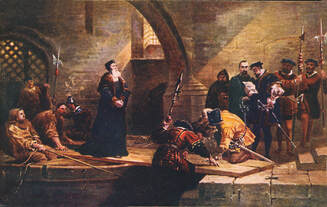
Thomas Cranmer is a name that holds great significance in the history of England and the Anglican Church. As the Archbishop of Canterbury during the reign of King Henry VIII and later during the reign of King Edward VI, Cranmer played a crucial role in shaping the religious and political landscape of England during the 16th century. This article will explore the life, career, and legacy of Thomas Cranmer, shedding light on his contributions to the Reformation and the Church of England.
Early Life and Education
Thomas Cranmer was born on July 2, 1489, in Aslockton, Nottinghamshire, England. He was the second son of Thomas Cranmer Sr. and his wife Agnes Hatfield. Cranmer was educated at the University of Cambridge, where he studied Greek and Latin, and became a fellow of Jesus College. He later became a lecturer in Greek at the university.
Soon afterwards, Cranmer married a young woman named Joan. As a result, he lost his fellowship at his own College. To support himself, he became a reader at Buckingham Hall. When Joan soon after died in childbirth, his fellowship was reinstated. Cranmer continued on at Jesus College and earned his doctorate in divinity in 1526. He remained there after he graduated and studied the Bible extensively. He began to see that the teachings of the Roman Catholic Church were in error, but he did not yet break away from the church.
Cranmer’s Early Career
Cranmer’s early religious views were conservative, and he initially opposed the ideas of the Protestant Reformation. However, his views began to change after he met Simon Grynaeus, a humanist from Basel and follower of Swiss reformers, who took an extended visit to England in 1531. Grynaeus struck up a friendship with Cranmer. After returning to Basel, he wrote about Cranmer to the German reformer, Martin Bucer in Strasbourg. These contacts initiated Cranmer’s eventual relationship with the Continental reformers, and they had a profound impact on Cranmer.
In 1532, Cranmer was appointed as the ambassador to the Holy Roman Emperor by King Henry VIII. His mission was to secure the emperor’s support for Henry’s proposed divorce from Catherine of Aragon. As the emperor traveled throughout his realm, Cranmer followed him. He passed through the city of Nuremburg and saw for the first time the effects of the Reformation.
While in Nuremberg, Cranmer met with Andreas Osiander, the leading architect of the Nuremberg reforms. They became good friends, and in July of that year, Cranmer married Margarete, the niece of Osiander’s wife. This was seen as open defiance of Church law, and it indicates the direction Cranmer’s attitude was moving toward eclesiastical authority and discipline.
In the fall of 1532, while Cranmer was following Emperor Charles through Italy, he received a royal letter informing him that he was appointed as the new Archbishop of Canterbury, succeeding William Warham. His appointment was seen as a significant victory for the reformers, as Cranmer was known to be sympathetic to their cause.
Cranmer and the English Reformation
Cranmer’s tenure as Archbishop of Canterbury coincided with one of the most significant periods in English history, the English Reformation. The Reformation was a period of religious and political upheaval in Europe, marked by the emergence of Protestantism and the decline of the power of the Catholic Church.
Under Henry VIII, the English Reformation was driven primarily by political and personal motives rather than religious conviction. Henry’s desire to divorce Catherine of Aragon and marry Anne Boleyn led him to break away from the Catholic Church. In 1533, Cranmer annulled Henry’s marriage to Catherine and declared his marriage to Anne Boleyn to be valid. This decision led to a break with Rome and the establishment of the Church of England as a separate entity. At the King’s bidding, Parliament passed and Act of Succession, which formally acknowledged the legitimacy of whatever offspring Henry’s new marriage would produce.
Cranmer’s role in the English Reformation movement was significant, as he used his position as Archbishop of Canterbury to create the new church’s liturgy and doctrine.
Reforms and the Church of England
Cranmer’s most significant contribution to the English Reformation was his creation of the Book of Common Prayer. The Book of Common Prayer was a new liturgy for the Church of England that replaced the Catholic Mass. The new liturgy was written in English rather than Latin and was designed to be accessible to the common people. The Book of Common Prayer was first introduced in 1549 and went through several revisions during Cranmer’s lifetime.
Cranmer’s reforms of the Church of England went beyond the creation of the Book of Common Prayer. He also worked to reform the church’s doctrine and practices, aligning them more closely with the teachings of the Protestant Reformation.
Cranmer believed that the church’s teachings should be based on the Bible rather than on tradition, and he worked to promote the Protestant doctrine of justification by faith alone. He also advocated for the removal of images and statues from churches, as he believed they were a distraction from the true worship of God.
As long as King Henry remained king, Cranmer could not institute much change in the English church. His reforms were met with resistance from some within the Church of England, as well as from conservative factions within the government. However, his influence over the Church of England continued to grow during the reign of Henry’s son, King Edward VI.
Edward VI was a devout Protestant and shared Cranmer’s vision for the Church of England. During his reign, Cranmer was able to implement further reforms, including the introduction of a new, more Protestant version of the Book of Common Prayer and the removal of Catholic practices such as the use of the crucifix and the elevation of the host during communion.
Cranmer’s Trial and Execution
Cranmer’s fortunes took a dramatic turn with the death of King Edward VI in 1553. Edward was succeeded by his Catholic half-sister Mary I, who was determined to restore Catholicism in England. Though Cranmer bravely remained at his post, hoping there could be some kind of co-existence possible, Mary had not forgiven the man who nullified her mother’s marriage. Cranmer was arrested in 1553 and imprisoned in the Tower of London, along with other Protestant leaders.
During his imprisonment, Cranmer was forced to recant his Protestant beliefs and to declare his allegiance to the Catholic Church. However, after Mary’s marriage to the Catholic King Philip II of Spain, she began a campaign of persecution against the Protestant reformers. Under pressure, Cranmer submitted to Mary’s demands that he return to the Catholic Faith and revoke Protestant beliefs.
Cranmer was one of the primary targets of this campaign, and he was put on trial for heresy in 1556. At his trial, Cranmer was once again forced to recant his Protestant beliefs. However, any hope that his recantation would save him soon vanished. His recantation was immediately published, but only to discredit him in the eyes of the public. For the church, only the death of the Archbishop could completely balance the account.
However, as he was being led to his execution, he retracted his recantation and declared that he believed in the Protestant doctrine of justification by faith alone. Cranmer was burned at the stake on March 21, 1556, and his death was seen as a symbol of the struggle between Catholicism and Protestantism in England.
Legacy of Thomas Cranmer
Thomas Cranmer was one of the most influential figures of the English Reformation and the Church of England. His creation of the Book of Common Prayer remains one of the most important works of English literature, and it has shaped the liturgy and worship of the Church of England for centuries.
Cranmer’s advocacy for the Protestant doctrine of justification by faith alone also had a lasting impact on the Church of England. His emphasis on the Bible as the source of Christian teaching and his rejection of Catholic practices such as the use of images and statues helped to shape the church’s identity as a Protestant institution.
Cranmer’s courage and conviction in the face of persecution and death also serve as an inspiration to Christians of all denominations. His willingness to stand up for his beliefs and to face the consequences of his actions has made him a symbol of the struggle for religious freedom and tolerance.
Reflections of the life of Thomas Cranmer
Having the wisdom to serve God pragmatically may yield long-term gains.
Knowing the best times to push for reform and other times when it’s better to wait requires wisdom from God.
Cranmer knew that Henry wanted authority over the English church for personal and political reasons, not for purposes of reform. So, he brought reforms to the church very slowly. But when Edward VI became king as a child and Cranmer became one of his regents, Cranmer knew this was the time to make greater strides in reforming the church. And when Mary, an ardent Catholic, became Queen of England, he was willing to try to forge a middle-ground between the Catholic church and the Reformed church.
Cranmer’s work has survived, even to this day. Various permutations of the Book of Common Prayer are used in churches in over 50 countries.
While a consistent testimony of faith in the face of persecution is commendable, persevering faith to the end is essential.
Martyrdom is not always one of unbroken triumph. It may sometimes take on the form of a victory being snatched out of the jaws of defeat.
Cranmer appears a very ordinary man, one who has no taste for violent death. But in his final hours God’s grace enabled him to endure to the end. What Cranmer taught as an evangelical, namely, that salvation is wholly the Lord’s work, was confirmed in his final hours.
Taking courage to face the consequences of your beliefs
There is a difference between the Reformers of the Christian church before Martin Luther and the Reformers beginning with Martin Luther and beyond. Before Martin Luther, the efforts of reform were aimed at reforming the Roman Catholic Church. However, for Luther and those who followed, reform was aimed at breaking away from the Roman Catholic Church.
How firmly do you stand with the Reformers of the sixteenth century? There’s no common ground between Roman Catholics and Protestants. The former rely on both faith and works for their salvation, while the latter rely solely on faith. By mixing works with faith, grace is no longer grace, and no one is eternally saved by their own works! (See Galatians 3:1-14) Luther explained justification this way in his Smalcald Articles:
The first and chief article is this: Jesus Christ, our God and Lord, died for our sins and was raised again for our justification (Romans 3:24-25). He alone is the Lamb of God who takes away the sins of the world (John 1:29), and God has laid on Him the iniquity of us all (Isaiah 53:6). All have sinned and are justified freely, without their own works and merits, by His grace, through the redemption that is in Christ Jesus, in His blood (Romans 3:23-25). This is necessary to believe. This cannot be otherwise acquired or grasped by any work, law, or merit. Therefore, it is clear and certain that this faith alone justifies us…Nothing of this article can be yielded or surrendered, even though heaven and earth and everything else falls (Mark 13:31).
Martin Luther
If you want to learn more about being reconciled to God, visit my blog, How to Begin Your Life Over Again. And click here, to view some excellent gospel YouTube presentations.
Sources and Related Posts
Diana Kleyn, Joel R. Beeke, Reformation Heroes: A Simple, Illustrated Overview of People Who Assisted in the Great Work of the Reformation. Reformation Heritage Books, Grand Rapids, MI. 2009. Chapter 13: Thomas Cranmer.
J. Kenneth Curtis, J. Stephen Land, Randy Petersen. The 100 Most Important Events in Christian History (paperback ed. 1998). Fleming H. Revell (Baker Book House). Grand Rapids, MI. pp. 108-109.
Thomas Cranmer. Retrieved from https://en.wikipedia.org/wiki/Thomas_Cranmer
Thomas Cranmer 1489-1556: Archbishop of Canterbury. Retrieved from https://www.historytoday.com/archive/thomas-cranmer-1489-1556-archbishop-canterbury