The Lollards were a group of itinerate preachers who followed the example of John Wycliffe and challenged the anti-bibical traditions of the Catholic Church. Using pages from the Wycliffe Bible and gospel tracts, these men of faith traveled throughout England preaching the supremacy of the Bible over the traditions of men. Despite facing intense persecution from the church and monarchy, the movement persisted and became popular among the common people.
The Lollard Movement
The Lollards were a group of anti-clerical English Christians who lived between the late 1300s and the early 1500s. The Lollards were followers of John Wycliffe, the Oxford University theologian and Christian Reformer who translated the Bible into vernacular English. Their commitment to the supreme authority of Scripture and to the exclusivity of the pure gospel was infectious and began to spread to others outside of Oxford.
“For the first time in English history an appeal was made to the people rather than to the scholars, and dogma was superseded by the Bible, which was made the sole source of faith and practice.”1Buddensieg. Lollards. The New Scaff-Herzog Encyclopedia of Religious Knowledge, vol. VII. p.15 Groups of dedicated men, who shared these beliefs, began to spring up in various locations around England by 1382.
The reformation historian, Merle D’Aubigne, noted: “The ‘poor priests,’ as they were called, set off barefoot, a staff in their hands, clothed in a course robe, living on alms, and satisfied with the plainest food… The people, among whom they were the favourites, thronged around them… They spoke with a popular eloquence that entirely won over those who listened to them.”2J.H. Merle d’Aubigne and S.M. Houghton, The Reformation in England, vol. 1. Banner of Truth Trust, Edinburgh, Scotland. 2015. pp. 70-71
In the beginning of the movement, the Lollards were mostly Oxford graduates trained by Wycliffe himself. But it soon spread to the general population as others joined the cause. Their influence was felt all over England and even into parts of Scotland.
Lollard beliefs considered heretical by the Catholic Church
The Lollards did not all share the same doctrinal beliefs of John Wycliffe, but they did share a common conviction that the inerrant Bible was the supreme source of authority. Wycliffe had equipped them with the core tenets of the gospel, and they fearlessly preached it. The Lollards insisted that all the Church’s teaching and institutions be tested against the record of God’s purposes in Scripture.
As the movement grew, a group of Lollards, who were members of Parliament, knew the vital importance of a sound theology. So in 1395, they wrote and published a synopsis of Wycliffe’s teaching in The Twelve Conclusions. It affirmed the core doctrines of salvation preached by Wyclife. It also refuted many papal errors, including the false teaching of transubstantion, pilgrimages, and prayers for the dead.
As the momentum of the Lollard movement grew, the King of England spoke out against their Twelve Conclusions. Consequently, the movement began to decline as a spiritual force. The preachers became less able to preach openly. Nevertheless, they continued their work out of the public eye.
Persecution of the Lollards
As early as the 1380s, the anti-Lollard movement started with a purge of Oxford, thus expelling the Lollard influence there. But the preaching continued into the fifteenth century despite the church’s view of the Lollards as being heretical. And in 1401, The English Parliament passed a new statute called De Heretico Comburendo, which means “On the Burning of a Heretic.”
This statute made preaching the true gospel a crime worthy of death. It empowered the bishops to initiate the arrest, examination, imprisonment, and martyrdom of the supposed “heretics” who contradicted the teaching of Rome. The first to die under this statute was William Sawtrey.
The burning of William Sawtrey in 1401
William was a priest at St. Margaret’s church in Lynn and Tilney, who preached and endorsed Lollard beliefs. In 1399, Bishop Henry le Despenser, ordered an examination of Sawtrey’s beliefs. The findings concluded that he rejected free will and that he did not believe in venerating images and embarking on pilrimages. He was therefore charged with heresy and sent to an episcopal prison. He then denounced Lollardy upon release, and on the next day, he swore that he would never preach Lollardy.
Sawtrey then moved to London in 1401 and began working as a parish-priest at St. Osyth’s, perhaps to distance himself from le Despenser. But his move didn’t distance himself from the anti-Lollard position of the Catholic Church. A year later, the De Heretico Comburendo statute was passed, which called for the burning of heretics, who plainly rejected Catholicism, or accepted Catholic beliefs but returned to their previous heretical beliefs. Under the examination by Archbishop Thomas Arundel, Sawtrey was once again charged with heresy.
After loosing his appeal to Parliament and refusing to convert back to Catholicism, he was charged for heresy once again. Since the law would not permit the execution of a cleric, he was stripped of all his clerical functions, attributes, and vestments in seven succcessive stages. Sawtrey was sentenced to death on February 26, 1401. He was taken to Smithfield to be publicly burned at the stake.
William Sawtrey was the first follower of Lollardy to die for his beliefs. It was one of the most egregious cases against Lollardy committed under the Statute of Heresy.
Other examples of Lollard persecutions by the Catholic Church
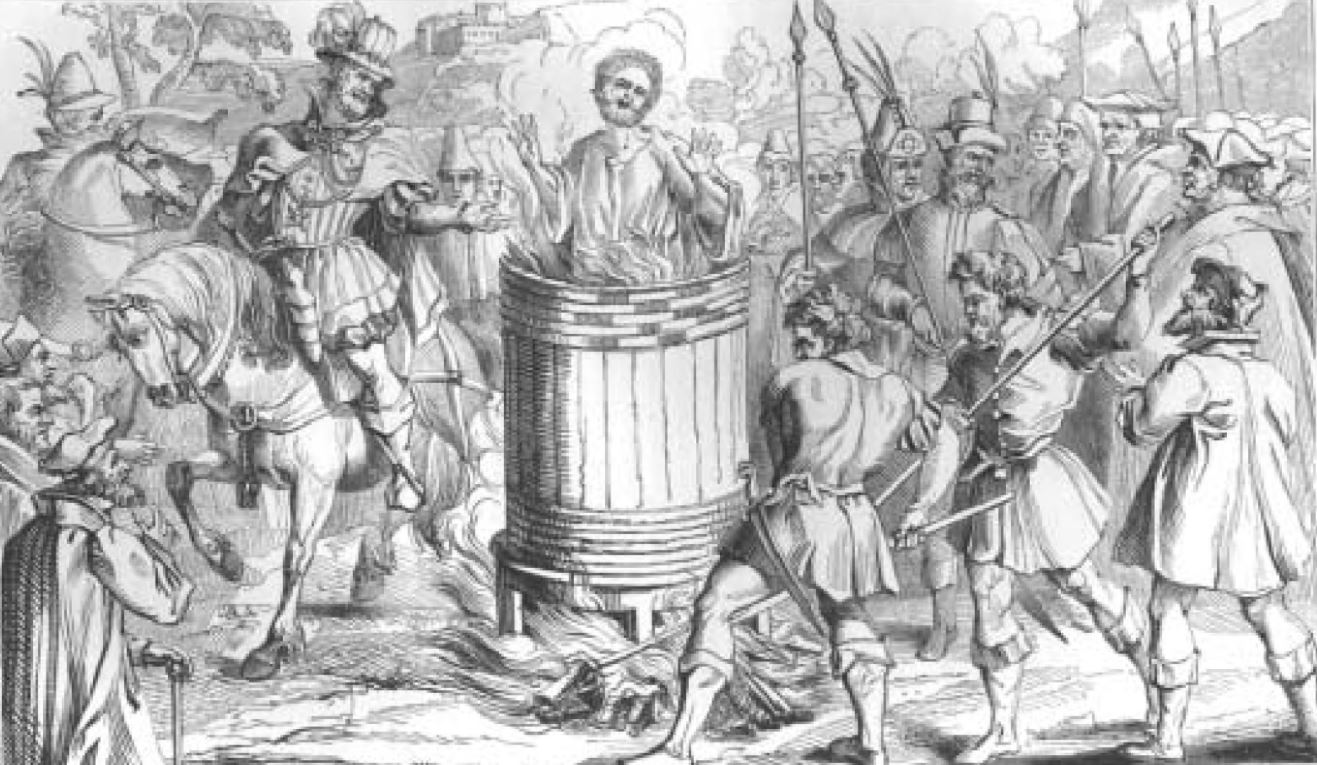
In 1410, John Badby was burnt to ashes for expressing Lollardy beliefs in a barrel at Smithfield. John was a tailor, born in 1380, who vehemently denied the doctrine to transubstantation. Archbishop Thomas Arundel and his brother-in-law presided over his second trial and condemnd Badby to be burned. The prince of Wales (later known as Henry V) witnessed the execution and offered Badby a life and pension if he would recant, but he refused to be delivered from the flames.
John Resby was an English priest, who supported John Wycliffe. In 1407, he was arrested in Perth, Scotland for believing teaching forty different Lollard heresies. He was executed by burning and is regarded as the first Protestant martyr in Scotland.
Thomas Bagley was an English priest, who was described as a valiant disciple of Wycliffe. He was accused of saying that if in the sacrament a priest made bread into God, he made a God that can be eaten by rats and mice. Bagley said that the monks, nuns, friars, and other privileged persons recognized by the church, were limbs of Satan. He was condemned for heresy and burnt at Smithfield in 1431.
Resistance against prosecution: the story of John Oldcastle
The early life of John Oldcastle
John Oldcastle (c. 1370 – 1417) was a knight who served Henry IV in battles in France and Wales, and was famous for his courage in battle. In the next few years, he represented the county of Herefordshire as a member of Parliament (1404), served as justice of the peace, and became High Sheriff of Herefordshire in 1406-07. In 1408, he married Joan, the heiress of of Cobham. This marriage was his third and her fourth. The Cobhams were one of the most notable families of Kent. So, the marriage resulted in much greater fortune and status for Oldcastle. From 1409-1413, he was summoned to Parliament as Baron Cobham.
The charge of heresy
During his military career, Oldcastle became a trusted supporter of Henry, Prince of Wales, who would later become King Henry V. When it was discovered that Oldcastle had adopted Lollard doctrines, he was accused of heresy. (Though not a preacher himself, he gave safe harbor and material aid to the followers of Wycliffe’s legacy.) Oldcastle declared that he would submit to the king all his fortune in the world, but was firm in his religious beliefs. The new King Henry V prevented any decisive action to be taken so he could try using his personal influence on Oldcastle.
After Oldcastle fled from Windsor Castle to his own castle, the king consented to a prosecution. Having refused to obey the archbishop’s repeated citations, it was only by a royal writ that he at last appeared. Since he confessed that he wouldn’t assent to the orthodox doctrine of the sacrament, admit the need of confession to a priest, and believe the veneration of images was idolatry, Oldcastle was convicted as a heretic. Following his conviction on September 23, 1413, he was imprisoned and condemned.
Oldcastle’s failed coup attempts.
In an attempt to crush the Lollard movement, the authorities gave Oldcastle forty days to reconsider and recant. During this time, however, he escaped from the Tower of London and conspired an attempt to capture King Henry V around Christmas time, during his stay in Eltham. The first attempt failed and another attempt was planned for early 1414. This coup attempt was also foiled when a spy apprised the king of the plan. Oldcastle escaped and avoided capture for nearly four years.
In November 1417, his hiding place was discovered and he was captured and brought back to London. He was formally condemned on December 14, 1417, based on his former conviction, and was hanged and burned that same day. Despite Oldcastle’s indiscretions in trying to capture the king, he remained faithful to the cause of Christ. His life demonstrates the high cost of faithfulness to the gospel and the Word of God.
The Lollard’s reputation tarnished
The failed coup attempy cost the Lollards a great deal of credibility with political leaders and wealthy aristocrats. From this time forward, the Lollard movement would mostly consist of common people, who were outside the power in England. The resulting lack of influential leadership forced the Lollards to go underground, where they operated mostly in London and in Southern England.
The Lantern of Light challenges the church’s authority
Despite growing opposition, the Lollards continued to fight for the authority of the Bible over the church’s worship and ministry. So, they produced the Lantern of Light, which is a Lollard tract, written early in the fifteenth century, containing an exposition, supported by passages from the Bible and from the writings of the Fathers and medieval divines, of the principal tenets of the followers of Wycliffe.
The Lollards wouldn’t tolerate the idea of lowering the infallible Word of God to any church hierarchy. Otherwise, they would be yielding its clear teaching to the fallible whims of men. So, they contended that the dogma of the established Roman Catholic Church was the cause of its internal weakness. Therefore, only a revival in preaching God’s Word would bring about the reform the church needed to restore its spiritual vitality.
Neverthless, the raging fires of persecution persisted. But God would ultimately bring good out of this persecution as it prepared the pathway for the Reformation in the sixteenth century.
The church’s attempt to extinguish the flames of reform
The condemnation of Wycliffe by the Council of Constance
In 1415, thirty-one years after Wycliffe died, the Council of Constance condemned him on 260 counts of heresy. The Council ordered that Wycliffe’s writings be burned and that his bones be exhumed and taken out of consecrated ground in the churchyard where he was buried. But in spite of the church’s opposition to Wycliffe’s Bible, its impact continued to be felt throughout England and even into the Europe.
Wycliffe’s ashes scattered
Furthermore, in 1428, the pope ordered that Wycliffe’s remains be dug up and burned. He also ordered that his ashes be scattered into the Swift River. In commenting on Wycliffe’s continuing influence, a historian noted, “They burnt his bones to ashes and cast them into the Swift, a neighboring brook running hard by. Thus the brook has conveyed his ashes into the Avon; Avon into Severn; Severn into the narrow seas; and they into the main ocean. And thus the ashes of Wycliffe are the emblem of his doctrine which now is disbursed the world over.”3Schaff and Schaff, History of the Christian Church, vol. VI, page 325.
Sources and References
Sources
Steven J. Lawson. The Bible Convictions of John Wycliffe. Ligonier Ministries, Sanford, FL.
https://en.wikipedia.org/wiki/William_Sawtrey
https://en.wikipedia.org/wiki/John_Badby
https://en.wikipedia.org/wiki/John_Resby
https://en.wikipedia.org/wiki/Thomas_Bagley_(priest)
https://en.wikipedia.org/wiki/John_Oldcastle
References
- 1Buddensieg. Lollards. The New Scaff-Herzog Encyclopedia of Religious Knowledge, vol. VII. p.15 ↩︎
- 2J.H. Merle d’Aubigne and S.M. Houghton, The Reformation in England, vol. 1. Banner of Truth Trust, Edinburgh, Scotland. 2015. pp. 70-71 ↩︎
- 3Schaff and Schaff, History of the Christian Church, vol. VI, page 325. ↩︎