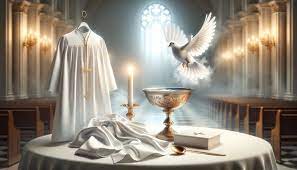
In Christianity, the practices known as sacraments (predominantly within Catholicism, Orthodoxy, and certain Anglican traditions) or ordinances (mainly within Protestant denominations) hold a vital place in the life of the believer and the community of faith. These rites—most universally, Baptism and the Eucharist (Communion or the Lord’s Supper)—serve as means of grace, signs of the believer’s faith, and acts of obedience to Jesus Christ.
This article delves into the scriptural basis, historical development, and theological significance of these foundational practices.
Scriptural Foundations
The New Testament provides the primary scriptural basis for the practices of Baptism and the Eucharist, grounding them in the life and commands of Jesus Christ.
– Baptism:
Matthew 28:19 records the Great Commission, where Jesus commands His disciples, “Go therefore and make disciples of all nations, baptizing them in the name of the Father and of the Son and of the Holy Spirit.” Baptism is thus seen as an initiation into the Christian faith, symbolizing the believer’s death to sin and new life in Christ (Romans 6:3-4).
– The Eucharist:
The institution of the Lord’s Supper is recorded in the Synoptic Gospels (Matthew 26:26-28, Mark 14:22-24, Luke 22:19-20) and 1 Corinthians 11:23-26. Jesus, at the Last Supper, breaks bread and shares wine with His disciples, commanding them to “do this in remembrance of me.” This rite commemorates Christ’s sacrifice on the cross and anticipates the messianic banquet in the kingdom of God.
In the book of Isaiah, we see this celebration of a meal at Yahweh’s table, where Isaiah looks beyond the disgrace of the exile.
“On this mountain the Lord Almighty will prepare
a feast of rich food for all peoples,
a banquet of aged wine —
the best of meats and the finest of wines.
On this mountain he will … swallow up death forever.
The Sovereign Lord will wipe away the tears from all faces;
he will remove the disgrace of his people from all the earth.”(Isaiah 25:6-8a)
It will be a time when God will “remove the disgrace of his people,” interpreted by the Jews as God sending his Messiah at the End of the Age.
Historical Development
The understanding and practice of Baptism and the Eucharist have evolved, yet they have remained central to Christian worship and theology since the earliest days of the Church.
– Early Church:
The Acts of the Apostles and early Christian writings indicate that Baptism and the breaking of bread (Eucharist) were foundational practices for the nascent Christian communities. These rites were integral to initiation, worship, and the communal life of believers.
– Patristic Era:
The Church Fathers wrote extensively on the significance and theology of the sacraments/ordinances, grounding them in Scripture and tradition. By the end of the patristic era, a more formalized understanding of the sacraments as means of grace and essential rites of the Christian faith had developed.
– Medieval Period:
During this time, the number and understanding of sacraments expanded within the Catholic Church, culminating in the recognition of seven sacraments at the Council of Trent (1545-1563). The sacramental theology emphasized the efficacy of the sacraments in conferring grace.
– Reformation:
The Protestant Reformation brought significant changes to sacramental theology. Reformers like Martin Luther and John Calvin sought to return to a more scripturally grounded understanding of the sacraments. While maintaining the importance of Baptism and the Eucharist, they rejected the notion of the sacraments as conveying grace ex opere operato (by the very fact of the action being performed) and instead emphasized faith as the means by which grace is received. This period also saw the terminology shift from “sacraments” to “ordinances” in many Protestant traditions, to emphasize their role as acts of obedience to Christ’s commands.
Theological Significance
– Means of Grace:
In traditions that use the term “sacraments,” these rites are seen as means by which God dispenses grace to the believer. They are not merely symbolic but are understood as real encounters with the grace of God.
– Signs of Faith and Obedience:
In traditions that prefer the term “ordinances,” these practices are viewed primarily as symbols of a believer’s faith and acts of obedience to Christ’s commands. They signify the believer’s identification with Christ in His death, burial, and resurrection (Baptism) and the community’s continual remembrance of Christ’s sacrifice (Eucharist).
– Community and Identity:
Both Baptism and the Eucharist play a crucial role in defining the community of believers—the Church. Baptism marks the entry into the Christian community, while the Eucharist sustains the believer’s spiritual life and fosters unity within the body of Christ.
Conclusion
Whether termed sacraments or ordinances, Baptism and the Eucharist are foundational to Christian practice and theology. They connect believers to the pivotal events of Christ’s death and resurrection, embedding the Christian life within the story of God’s redemptive work. Across diverse Christian traditions, these rites continue to serve as vital expressions of faith, means of grace, and acts of obedience, shaping the identity and life of the Christian community through the centuries.
Other Resources Available:
- FaithAnswersPress.net: Grow in your faith and share your hope with others. Find biblical answers about the Christian faith. VISIT THE SITE NOW
- Download the FAQs of Faith app for easy access to Faith Answers Press LLC websites, answers to spiritual FAQs, and a daily faith-boosting podcast. DOWNLOAD NOW